

Manufacturers have spent years hearing about the promise of predictive maintenance in manufacturing. Sensors, dashboards, machine learning, and real time alerts all promise better reliability and lower downtime.
Yet many operations leaders are still asking the same question:
Where is the Actual Business Value?
The reality is that many predictive maintenance initiatives stall before they ever impact operations. Data gets collected but not acted on. Pilot programs never scale. Maintenance teams continue firefighting while AI tools remain disconnected from daily execution.
The companies seeing measurable ROI from AI predictive maintenance in manufacturing are taking a different approach. They are not treating AI as a standalone technology project. They are integrating it directly into maintenance execution, operational management systems, and plant floor decision making.
That is where predictive maintenance starts driving EBITDA.
What Is AI Predictive Maintenance in Manufacturing?
AI predictive maintenance uses operational and equipment data to identify failure patterns before breakdowns occur. Instead of relying only on preventive maintenance schedules or reactive repairs, manufacturers can predict when equipment conditions are deteriorating and intervene earlier.
Common data inputs include:
- Vibration monitoring
- Temperature data
- Pressure readings
- Acoustic monitoring
- Energy consumption
- Production performance data
- Maintenance history
- Operator observations
AI models analyze these patterns to identify anomalies, predict failures, and recommend maintenance actions before downtime occurs.
But technology alone is not enough.
Manufacturers achieving real results connect predictive insights directly to maintenance planning, scheduling, operations leadership, and execution accountability.
Why Many Predictive Maintenance Programs Fail
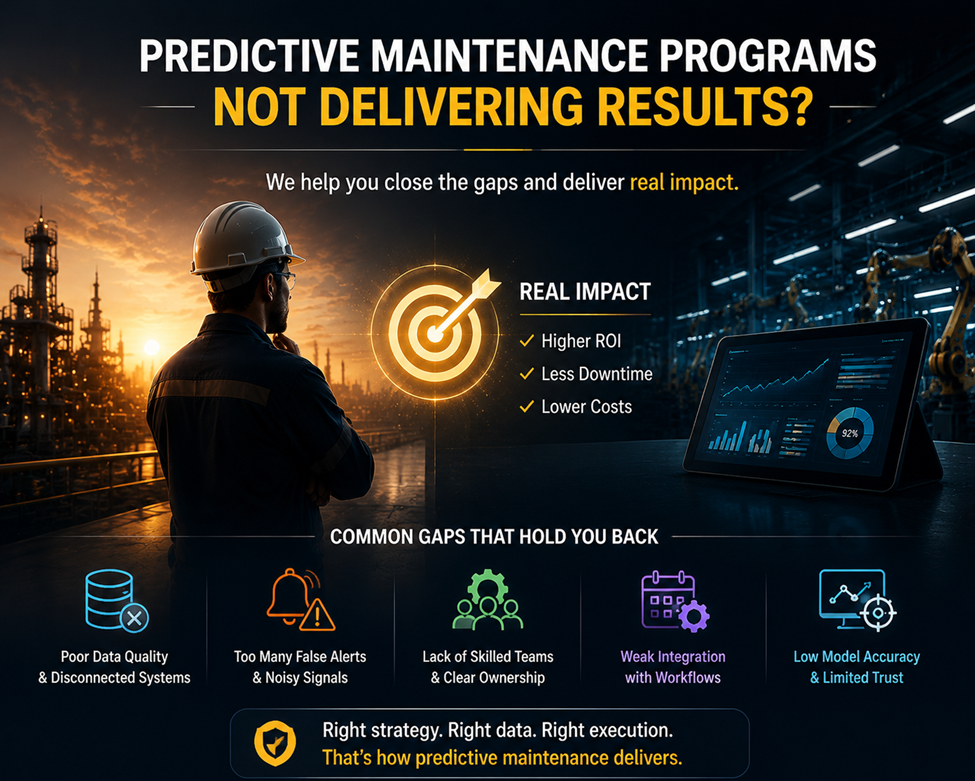
Many organizations invest in predictive maintenance technology but never achieve operational impact.
Common problems include:
- Data exists but is not actionable
- Alerts are ignored or not trusted
- Maintenance teams are overloaded with false positives
- No connection between AI systems and maintenance workflows
- Plants lack standardized maintenance execution processes
- No Management Operating System (MOS) to drive accountability
- Pilot programs remain isolated from broader operations
This is why many predictive maintenance initiatives become dashboard projects instead of operational transformations.
The issue is rarely the AI itself.
The issue is execution.
Where AI Predictive Maintenance Delivers Real ROI
The strongest predictive maintenance programs focus on operationally critical assets where downtime directly impacts throughput, quality, cost, or service levels.
Equipment Reliability and Downtime Reduction
One of the most common applications is identifying early warning signs of equipment failure before unplanned downtime occurs.
AI models can detect:
- Bearing degradation
- Motor failure risk
- Abnormal vibration patterns
- Temperature anomalies
- Hydraulic pressure deviations
- Pump performance deterioration
Instead of reacting after a breakdown, maintenance teams can intervene during planned downtime windows.
The impact often includes:
- Reduced unplanned downtime
- Higher asset availability
- Improved schedule stability
- Lower emergency maintenance costs
- Reduced overtime
In asset intensive manufacturing environments, even small uptime improvements can create significant financial impact.
AI Driven Water Infrastructure Maintenance
Predictive maintenance is not limited to traditional manufacturing environments.
In one AI driven infrastructure application, machine learning was used to identify and predict water distribution system failures before major asset breakdowns occurred. The system analyzed operational patterns and infrastructure conditions to identify hidden leak risks and deterioration trends.
The result was improved asset life, reduced water loss, and more proactive maintenance planning.
This is where AI becomes operationally valuable, not simply generating alerts, but enabling earlier intervention and smarter resource allocation.
Predictive Maintenance and Production Stability
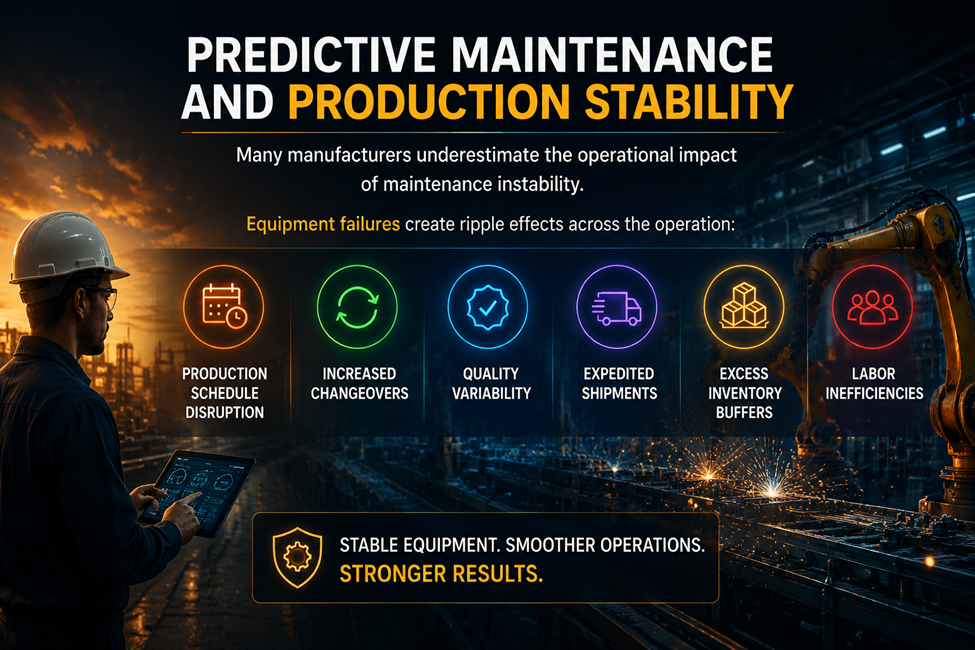
Many manufacturers underestimate the operational impact of maintenance instability.
Equipment failures create ripple effects across the operation:
- Production schedule disruption
- Increased changeovers
- Quality variability
- Expedited shipments
- Excess inventory buffers
- Labor inefficiencies
AI predictive maintenance helps stabilize production by reducing variability caused by equipment performance issues.
This becomes especially valuable in:
- Food manufacturing
- Electronics manufacturing
- Chemicals
- Pulp and paper
- Heavy industrial operations
- Utilities and infrastructure environments
The goal is not simply fewer breakdowns.
The goal is more predictable operations.
AI for Maintenance Planning and Scheduling
Another high value use case is improving maintenance planning itself.
AI can help organizations:
- Prioritize maintenance work orders
- Predict spare part requirements
- Optimize technician scheduling
- Identify recurring failure trends
- Improve shutdown planning
- Reduce maintenance backlog
This moves maintenance organizations from reactive firefighting toward proactive execution.
In many facilities, this shift alone drives major productivity improvements.
The Role of Digital MOS in Predictive Maintenance
One of the biggest gaps in predictive maintenance implementation is operational follow through.
An alert only creates value if the organization acts on it consistently.
This is why leading manufacturers integrate predictive maintenance into a Digital Management Operating System (MOS).
A Digital MOS creates:
- Real time visibility into asset performance
- Escalation management workflows
- Accountability structures
- Standardized KPI management
- Faster response to emerging issues
- Cross functional coordination between maintenance and operations
Without execution systems in place, AI insights often remain disconnected from day to day operations.
Benefits of AI Predictive Maintenance in Manufacturing
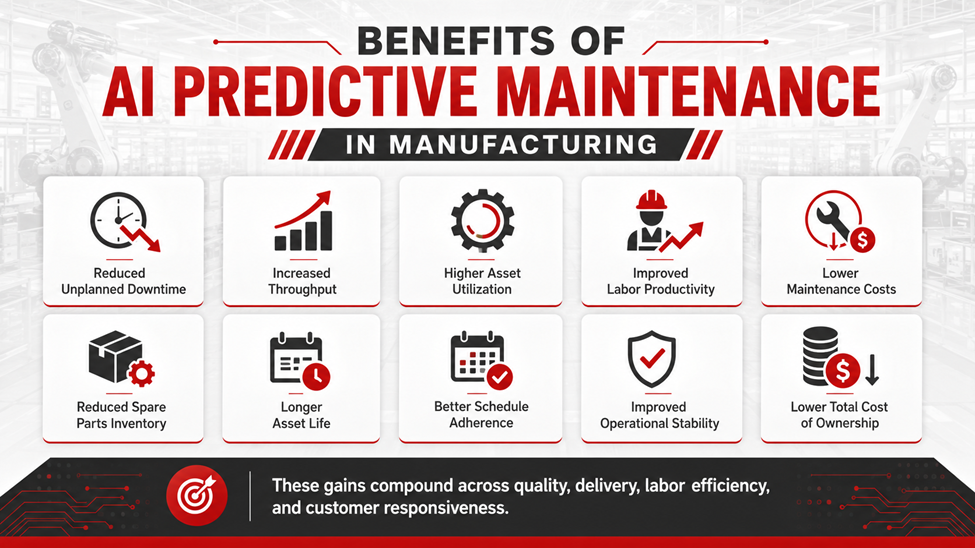
When implemented effectively, AI predictive maintenance can deliver:
- Reduced unplanned downtime
- Increased throughput
- Higher asset utilization
- Improved labor productivity
- Lower maintenance costs
- Reduced spare parts inventory
- Longer asset life
- Better schedule adherence
- Improved operational stability
- Lower total cost of ownership
Most importantly, these improvements compound across the operation.
A more reliable production environment improves quality, delivery performance, labor efficiency, and customer responsiveness simultaneously.
Predictive Maintenance Is an Execution Challenge
Many organizations already have the technology required to improve maintenance performance.
What they often lack is the operational structure to execute consistently.
Predictive maintenance succeeds when companies:
- Align maintenance and operations
- Standardize execution processes
- Build accountability systems
- Integrate AI into daily management
- Focus on operational adoption, not just technology deployment
- Scale successful use cases across the enterprise
AI is not replacing maintenance teams.
It is helping experienced teams make faster, smarter, and more proactive decisions.
Final Thoughts
AI predictive maintenance in manufacturing is no longer theoretical. The technology exists. The use cases are proven. The operational value is real.
But ROI does not come from dashboards alone.
Manufacturers seeing the greatest results are embedding predictive maintenance into the way the business operates every day. They connect AI insights to execution, accountability, maintenance workflows, and operational leadership.
That is where predictive maintenance moves from experimentation to measurable business impact.
Frequently Asked Questions
Where does AI predictive maintenance generate the highest ROI?
ROI appears when predictive insights are directly connected to maintenance execution, scheduling, and operational decision making. Reducing downtime on critical assets improves throughput, asset utilization, and overall operational efficiency.
Why do predictive maintenance programs fail?
Most predictive maintenance initiatives fail because organizations focus only on technology while ignoring execution. Poor workflow integration, lack of accountability, false positives, and weak operational adoption are common problems.
What is the role of a Digital MOS in predictive maintenance?
A Digital Management Operating System helps organizations operationalize predictive insights. It creates visibility, accountability, escalation workflows, and coordination between maintenance and operations teams.
Which industries benefit most from AI predictive maintenance?
Industries with asset intensive operations see the strongest benefits, including food manufacturing, chemicals, electronics, utilities, heavy industry, pulp and paper, and infrastructure operations.
What metrics should manufacturers track to measure predictive maintenance ROI?
Key metrics include:
- Unplanned downtime reduction
- Asset availability
- Maintenance cost reduction
- Labor productivity
- Throughput improvement
- Schedule adherence
- Spare parts inventory reduction
- Asset life extension