
Introduction
Life sciences manufacturers face increasing pressure to reduce costs, improve productivity, accelerate product launches, strengthen supply chains, and maintain compliance in an increasingly complex regulatory environment. At the same time, many organizations are investing heavily in AI, digital technologies, and operational improvement initiatives to remain competitive. For many, partnering with a life sciences consulting firm accelerates progress on digital and operational priorities.
While many consulting firms help develop strategies, operational success depends on execution. The ability to implement improvements across manufacturing, quality, supply chain, maintenance, and digital operations is what ultimately drives measurable business results.
Whether you manufacture pharmaceuticals, biotechnology products, medical devices, or diagnostics, the right life sciences consulting partner should help your organization improve operational performance, not simply produce recommendations.
Why Life Sciences Manufacturers Seek Consulting Support
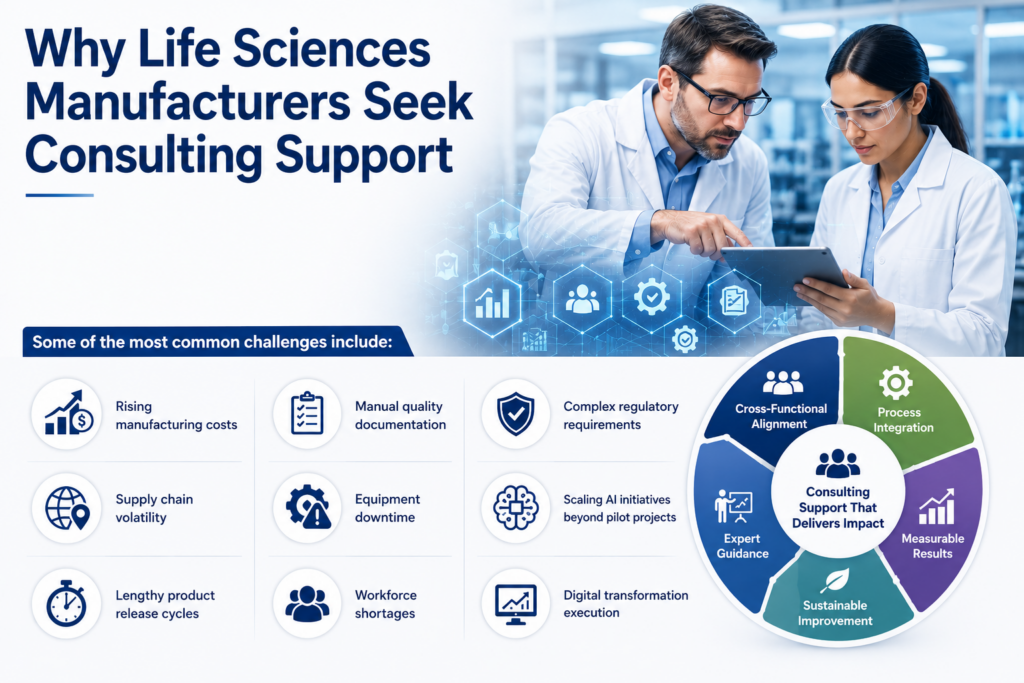
Operational challenges have become increasingly interconnected. Improvements in one area often depend on changes across multiple functions. This is where experienced life sciences manufacturing consulting can create measurable value by coordinating change across adjacent processes.
Some of the most common challenges include:
- Rising manufacturing costs
- Supply chain volatility
- Lengthy product release cycles
- Manual quality documentation
- Equipment downtime
- Complex regulatory requirements
- Workforce shortages
- Scaling AI initiatives beyond pilot projects
- Digital transformation execution
Organizations often recognize these opportunities but struggle to translate improvement initiatives into sustainable operational change.
Where the Greatest Opportunities Exist
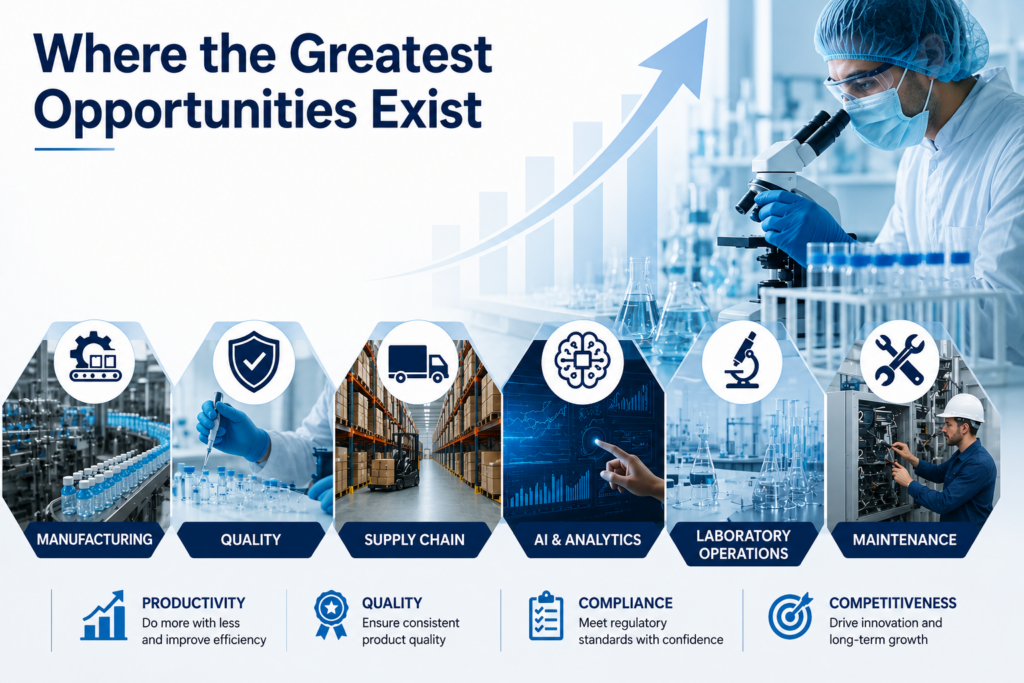
Life sciences manufacturers continue to invest in operational improvements that strengthen productivity, quality, compliance, and long-term competitiveness. The greatest opportunities typically span manufacturing, quality, supply chain, AI, laboratory operations, and maintenance.
Manufacturing Operations
Manufacturing remains one of the largest opportunities for operational improvement.
Life sciences organizations continue to focus on:
- Improving throughput
- Reducing cycle times
- Increasing Overall Equipment Effectiveness (OEE)
- Eliminating waste
- Standardizing work
- Improving production scheduling
Rather than isolated improvement projects, leading organizations are implementing structured operating systems that create sustainable performance improvements across multiple manufacturing sites.
Quality and Regulatory Operations
Quality systems directly affect cost, lead time, and customer service.
Many organizations continue to rely on manual documentation, multiple review cycles, and paper-based processes that increase labor requirements while introducing opportunities for error.
Digital quality systems, including electronic Device History Records (eDHR), are helping manufacturers automate documentation, reduce manual data entry, improve traceability, and accelerate product release while maintaining compliance.
One implementation highlighted in your leadership briefing replaced manual documentation with integrated digital workflows, resulting in significant annual savings, reduced manual entries, and fewer documentation errors.
Supply Chain
Supply chains have become significantly more complex.
Manufacturers are working to improve:
- SIOP
- Demand planning
- Production scheduling
- Forecast accuracy
- Inventory optimization
- Master data integrity
Real-world projects show that many organizations still rely on manual planning processes, inconsistent metrics, and fragmented forecasting approaches that limit scalability and growth.
Building stronger planning processes and reliable master data creates the operational foundation for long-term improvement.
AI and Digital Transformation
Artificial intelligence has moved well beyond experimentation.
Many life sciences companies have already established AI governance, identified use cases, and deployed copilots. The challenge now is embedding AI into operational workflows where it delivers measurable business value. Your leadership briefing emphasizes that the gap is no longer strategy. It is execution.
AI is already being applied across regulated environments for quality, manufacturing, supply chain, and operational processes.
Examples include:
- AI-assisted quality inspection
- Predictive maintenance
- AI-driven production scheduling
- Intelligent supply chain planning
- Regulatory document automation
- Laboratory knowledge retrieval
- Digital manufacturing execution
The organizations realizing the greatest value are integrating AI into daily operations rather than treating it as a standalone technology initiative.
Laboratory Digital Transformation
For research organizations, one of the biggest opportunities lies in improving how scientific data is captured, structured, and reused.
Effective laboratory digital transformation depends on consistent data models, standardized templates, and interoperable systems.
Many laboratories generate enormous amounts of valuable experimental data, but inconsistent templates, free-text documentation, and fragmented data structures make it difficult to search, analyze, or leverage that information effectively.
Improving data structure, standardizing templates, and creating stronger digital foundations enables AI tools to deliver more meaningful insights while improving collaboration across scientific teams.
The Merck Signals work illustrates how harmonizing templates and structured data can accelerate access to research knowledge and improve the value organizations derive from their scientific data.
Maintenance and Reliability
Equipment reliability directly affects production output, compliance, and operating costs.
Predictive maintenance, digital maintenance systems, and structured reliability programs help organizations reduce downtime while improving asset performance and production stability.
Rather than reacting to failures, leading manufacturers are building maintenance systems that proactively identify and address issues before they impact production.
What to Look for in a Life Sciences Consulting Firm
When evaluating life sciences consulting firms, including those specializing in life sciences manufacturing consulting, organizations should look beyond strategic recommendations.
The most effective partners combine industry expertise with implementation capabilities, including:
- Manufacturing operations improvement
- Supply chain optimization
- Quality system transformation
- AI implementation
- Digital manufacturing
- Change management
- Performance management
- Sustainable operational execution
The goal should be measurable operational improvement, not simply delivering a report.
From Strategy to Sustainable Results
Operational excellence in life sciences manufacturing requires more than technology investments or strategic plans. Lasting improvements come from aligning people, processes, digital technologies, and execution around measurable business objectives.
Whether the objective is improving manufacturing throughput, modernizing quality systems, strengthening supply chains, implementing AI, or accelerating digital transformation, success ultimately depends on implementation.
Organizations that combine operational expertise with disciplined execution, often in partnership with experienced life sciences consulting teams, are better positioned to improve productivity, reduce costs, strengthen compliance, and create sustainable competitive advantage.
FAQs
Why do life sciences manufacturers seek consulting support instead of handling improvements internally?
Short answer: Because today’s operational challenges are tightly interconnected, improvements in one area often depend on coordinated changes across manufacturing, quality, supply chain, maintenance, and digital operations. Many organizations know where opportunities exist but struggle with execution, turning strategies and pilots into sustainable, cross-functional change. Experienced life sciences consulting partners help orchestrate end-to-end execution, bridge gaps between functions, and accelerate measurable results.
Where are the biggest opportunities for operational improvement right now?
Short answer: The greatest gains typically come from coordinated improvements across:
- Manufacturing operations (throughput, cycle times, OEE, waste elimination, standard work, production scheduling, and site-wide operating systems)
- Quality and regulatory (digital quality systems like eDHR to automate documentation, improve traceability, and speed release)
- Supply chain (stronger SIOP, demand planning, inventory optimization, and master data integrity to replace manual, fragmented approaches)
- AI and digital transformation (embedding AI into workflows for quality, manufacturing, supply chain, and operations)
- Laboratory digital transformation (structured data models, standardized templates, interoperable systems, including harmonization like the Merck Signals work)
- Maintenance and reliability (predictive maintenance and structured reliability programs to reduce downtime)
How do digital quality systems such as eDHR improve speed, cost, and compliance?
Short answer: They replace manual, paper-based documentation with integrated digital workflows that reduce manual data entry, cut errors, and enhance traceability. This streamlines reviews and accelerates product release while maintaining regulatory compliance. As highlighted in the leadership briefing example, these implementations can yield significant annual savings alongside measurable quality improvements.
What is the key to getting real value from AI in regulated life sciences environments?
Short answer: Execution. Embedding AI directly into operational workflows rather than treating it as a standalone initiative. Organizations that have governance and use cases in place gain value by operationalizing AI in areas like AI-assisted inspection, predictive maintenance, AI-driven scheduling, intelligent supply chain planning, regulatory document automation, laboratory knowledge retrieval, and digital manufacturing execution. The leaders integrate AI into daily work so it consistently drives measurable business outcomes.
What should we look for in a life sciences consulting firm to ensure results rather than just recommendations?
Short answer: Prioritize partners that pair deep industry expertise with hands-on implementation capabilities, including manufacturing operations improvement, supply chain optimization, quality system transformation, AI implementation, digital manufacturing, change management, performance management, and sustainable operational execution. The hallmark of the right partner is measurable operational improvement, not a report, achieved by aligning people, processes, and technology around clear business objectives.