
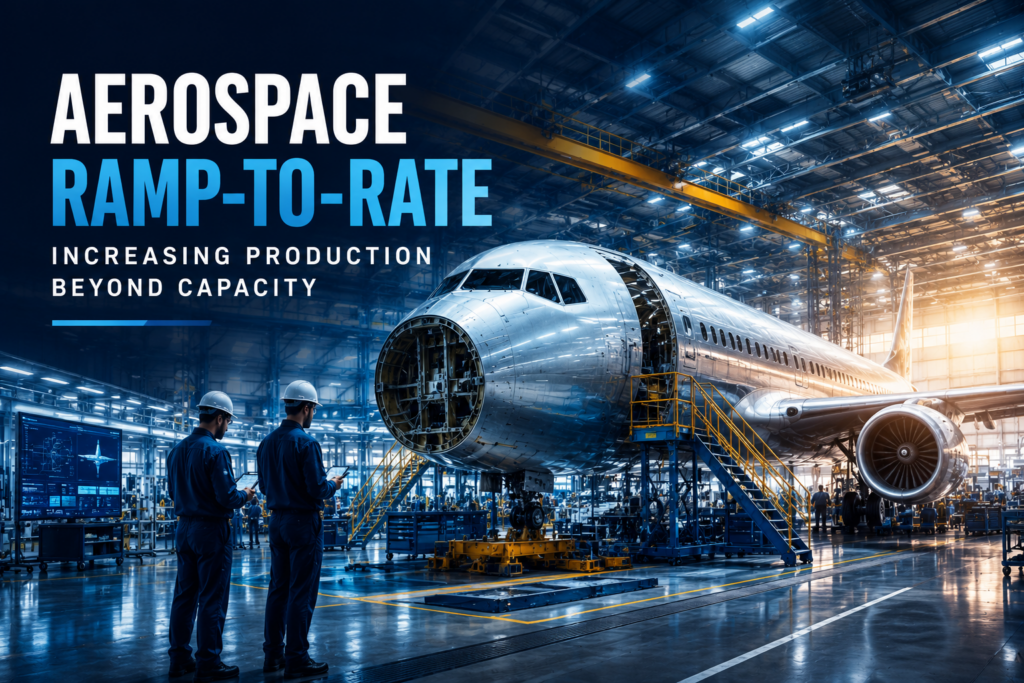
Global demand is placing unprecedented pressure on aerospace and defense manufacturers to increase production. Commercial aircraft programs are accelerating defense spending is rising and suppliers throughout the value chain are being asked to deliver significantly higher volumes often within aggressive timelines.
For many manufacturers the first instinct is to add capacity. Hire more people. Purchase additional equipment. Expand facilities.
While those investments are sometimes necessary they rarely solve the underlying challenge.
Successful ramp-to-rate initiatives are not driven by capacity alone. They require an integrated operational strategy that aligns production supply chain quality maintenance warehouse operations and leadership around a common objective. Organizations that focus only on adding resources often discover that existing operational constraints simply become larger as production volumes increase.
The Constraint Usually Isn’t Where You Think It Is
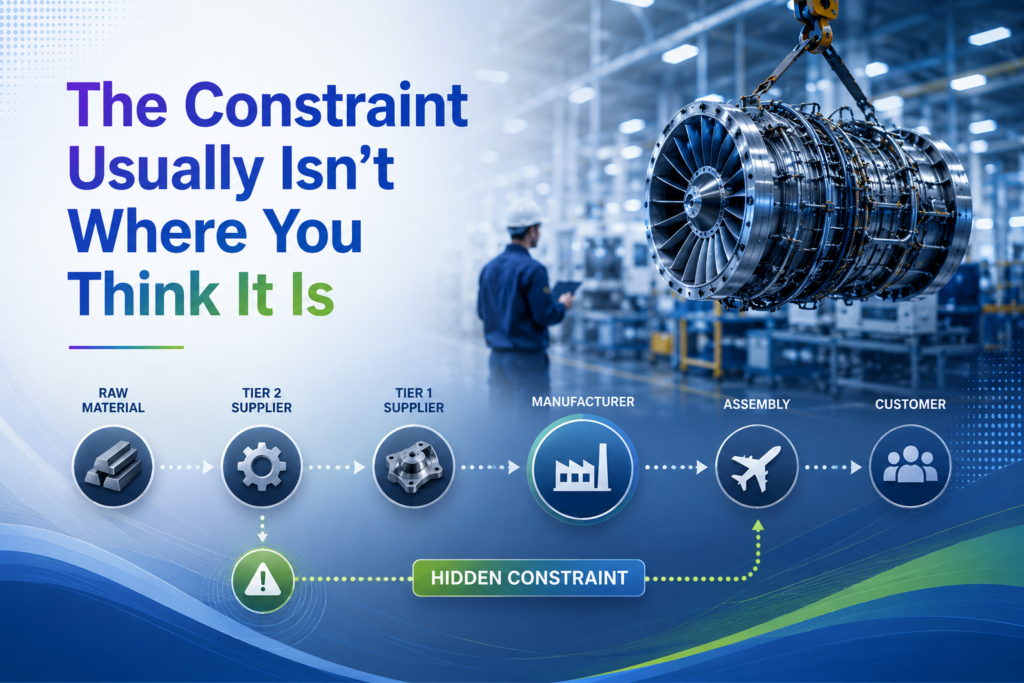
When production targets increase organizations often assume that manufacturing capacity is the primary bottleneck. In reality capacity constraints frequently exist elsewhere.
A production line cannot achieve higher output if materials arrive late quality issues create excessive rework equipment reliability limits uptime or supervisors spend their day reacting to problems instead of managing performance.
In many aerospace facilities these constraints have developed gradually over years of program changes engineering revisions and facility expansions. Existing processes may have supported historical production volumes but they were never designed to sustain the rates now being demanded.
The result is predictable:
- Production schedules become unstable
- Material shortages increase
- Work-in-process accumulates
- Expediting becomes routine
- Teams work harder but output improves only marginally
Increasing capacity without addressing these underlying constraints often accelerates inefficiency rather than production.
Ramp-to-Rate Requires an Integrated Operational Approach
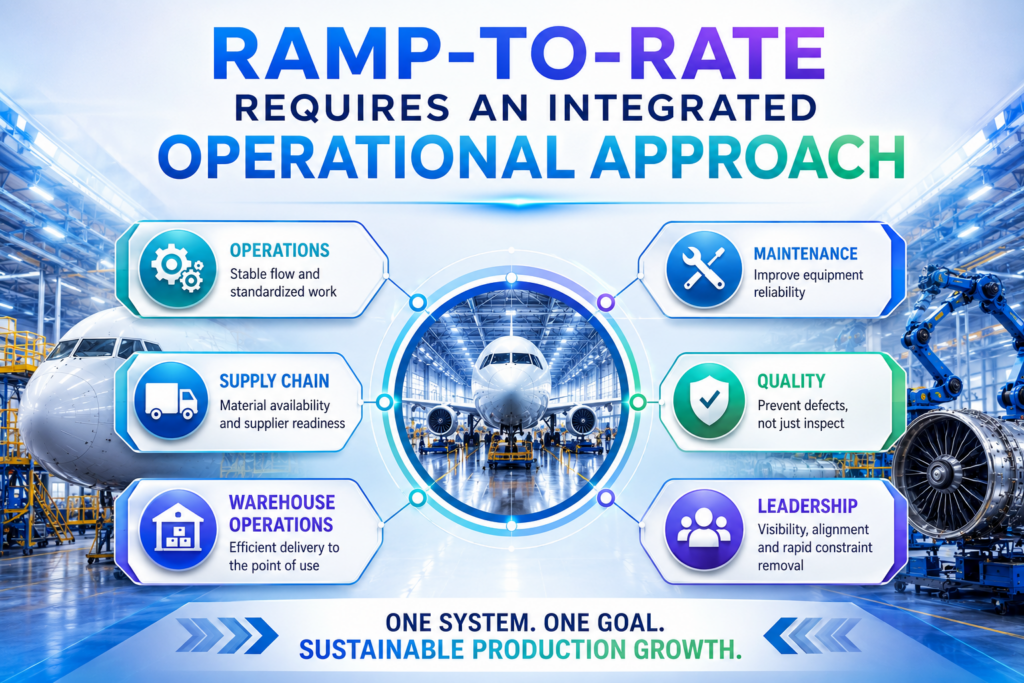
The most successful aerospace production ramps treat the operation as an interconnected system rather than a collection of individual departments.
Every function influences production performance:
- Operations must establish stable flow and standardized work
- Supply chain must ensure material availability and supplier readiness
- Warehouse operations must deliver material efficiently to the point of use
- Maintenance must improve equipment reliability before production volumes increase
- Quality systems must prevent defects rather than inspect them after the fact
- Leadership must create visibility into performance and remove constraints quickly
Recent aerospace ramp-to-rate programs we’ve supported have reflected this integrated approach combining Lean transformation production control warehouse and material-flow redesign management operating systems first-pass yield improvement and equipment reliability into a coordinated execution plan rather than treating them as separate initiatives.
Material Flow Often Becomes the Hidden Constraint
One of the least appreciated aspects of production ramp-up is material flow. Manufacturers frequently focus on production cells while overlooking how material moves throughout the facility.
As production increases inefficient warehouse layouts inconsistent picking processes poor inventory visibility and excessive material handling can quickly become major constraints.
Supporting higher production rates requires more than additional inventory. It requires standardized warehouse processes point-of-use material delivery improved transactional accuracy optimized layouts and production scheduling that aligns with actual manufacturing demand.
Several recent aerospace programs have placed warehouse operations and material flow at the center of production ramp planning not as supporting activities but as critical enablers of manufacturing performance.
Supplier Capacity Is Part of Your Capacity
Aerospace manufacturers cannot successfully increase production if their suppliers cannot. As highlighted in recent aerospace defense manufacturing news this is particularly important as OEMs ask suppliers to support aggressive production increases across multiple programs simultaneously.
Supplier readiness extends far beyond available machine capacity. Organizations should understand whether suppliers have adequate production capacity stable quality systems strong sub-tier supplier management financial capability to support investment leadership capable of managing rapid growth and operational discipline to sustain higher production rates.
Supplier capacity validation has become an increasingly important part of aerospace ramp planning because disruptions often originate several tiers upstream long before they become visible at the final assembly facility.
Production Readiness Starts Before Production Increases
One of the biggest misconceptions surrounding ramp-to-rate initiatives is that preparation begins once production targets have increased. In reality the work begins much earlier.
Successful programs invest significant effort in production readiness by evaluating facility layouts mapping value streams designing material flow establishing governance defining performance metrics planning implementation phases and preparing leadership teams before production rates increase. The goal is to eliminate operational constraints before they become production problems.
This preparation creates a stable operational foundation capable of supporting sustained growth rather than temporary output gains.
Daily Management Determines Whether the Ramp Succeeds
Even the best production plans require disciplined execution. As production volumes increase problems occur faster and propagate further across the operation.
Without structured daily management organizations often lose visibility into emerging constraints until they begin affecting delivery performance.
Leading aerospace manufacturers establish management operating systems that provide real-time production visibility tiered performance reviews rapid problem escalation action tracking cross-functional coordination and leader standard work.
These routines help organizations identify and resolve issues before they affect customer commitments enabling production increases to remain stable over time rather than relying on constant firefighting.
The Goal Isn’t More Capacity—It’s Sustainable Throughput
The most successful aerospace manufacturers don’t simply produce more. They build operations capable of producing more predictably.
That distinction matters. Organizations focused only on capacity often experience increasing overtime higher inventory levels quality concerns and schedule instability.
Organizations focused on operational execution improve throughput by strengthening the entire production system. They optimize flow improve first-pass yield strengthen supplier performance increase equipment reliability standardize management routines create visibility into operational performance and only then add capacity where it is genuinely required.
Final Thoughts
Production ramp-up is one of the most complex challenges facing aerospace and defense manufacturers today. Success depends on far more than adding people purchasing equipment or expanding facilities. It requires an integrated operational strategy that aligns manufacturing supply chain warehouse operations quality maintenance and leadership around a common objective.
Manufacturers that invest in these operational foundations are better positioned to increase throughput improve delivery performance reduce disruption and sustain higher production rates as demand continues to grow.
Ultimately successful ramp-to-rate initiatives are not capacity projects. They are operational transformation projects.
FAQs
Why doesn’t adding people machines or floor space alone solve ramp-to-rate challenges?
Because the real bottlenecks often lie outside pure manufacturing capacity. If materials arrive late quality drives rework or equipment uptime is unstable adding capacity just scales the inefficiency.
What does an integrated ramp-to-rate approach include and when should it start?
Treat the plant as an interconnected system and begin preparation before rates rise. Align operations supply chain warehouse maintenance quality and leadership with Lean production control material flow management systems and reliability improvements.
Why does material flow become a hidden constraint and how do we fix it?
As rates increase inefficient warehouse layouts and poor material handling choke flow. Fix it with standardized processes point-of-use delivery optimized layouts and scheduling tied to real demand.
How should manufacturers ensure suppliers are ready to support higher rates?
Treat supplier capacity as part of your own. Validate production quality sub-tier management financial health and operational discipline. Proactive supplier readiness is essential.
What daily management is needed to keep the ramp stable?
Use a management operating system with real-time visibility tiered reviews rapid escalation action tracking and leader standard work. Success is sustainable throughput not just more capacity.