
Artificial intelligence is no longer optional in manufacturing, and a clear AI implementation strategy is now becoming a baseline expectation.
Many companies have already invested in AI strategy, pilot programs, or digital transformation efforts. Some have partnered with AI consulting firms to define opportunities and build roadmaps.
But despite all of this activity, the results often fail to show up where they matter most.
Margins do not improve.
Throughput stays constrained.
Operations do not fundamentally change.
The issue is usually not the technology itself.
It is the gap between AI consulting and AI implementation, and the lack of a practical AI implementation roadmap that connects strategy to execution inside the operation.
The Reality: Most AI Strategies Never Deliver Value
For years, companies have followed the same pattern:
- Hire a consulting firm
- Define the strategy
- Identify opportunities
- Launch pilot programs
On paper, the process looks solid.
In practice, most initiatives stall before meaningful value is realized.
Research has repeatedly shown that most strategic initiatives fail to deliver their intended results. AI is no different.
Most organizations do not fail because the ideas are wrong.
They fail because the implementation never fully happens.
What AI Consulting Actually Delivers
AI consulting and AI strategy consulting firms play an important role. They help organizations:
- Define AI strategy
- Identify use cases
- Assess data readiness
- Build business cases
- Recommend technologies
This work matters. But it is only the starting point.
Because none of it changes operations on its own.
At the end of many AI consulting engagements, companies are left with:
- An AI implementation strategy roadmap
- Recommendations
- Pilot concepts
What they often do not have is execution at scale.
Without integration into daily workflows and operational systems, the value never fully materializes.
Where AI Strategies Break Down
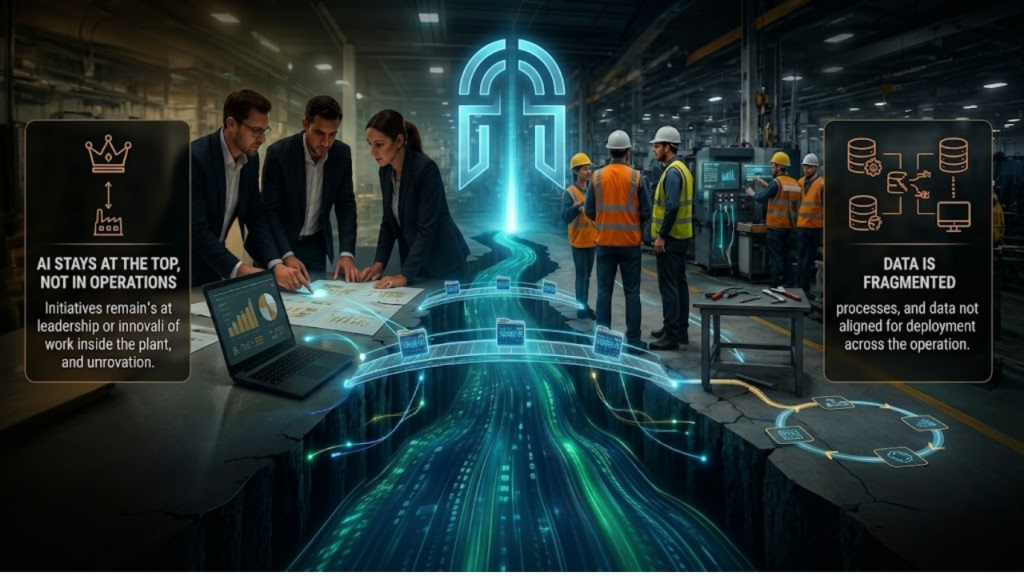
The failure rarely happens at the strategy level.
It happens when companies try to operationalize AI. A practical AI implementation strategy must bridge the gap between consulting recommendations and real execution on the shop floor.
This is where most organizations struggle.
AI stays at the top, not in operations
Initiatives remain at the leadership or innovation level instead of becoming part of daily work inside the plant.
Pilots never scale
A successful proof of concept stays isolated and never becomes an operational capability.
Data is fragmented
Systems, processes, and data are not aligned well enough to support deployment across the operation.
AI is disconnected from workflows
Tools exist outside the way teams actually work, so adoption stays low.
No ownership for execution
No team owns implementation, sustainment, or long-term operational integration.
The result is predictable.
AI becomes a collection of disconnected experiments instead of a meaningful operational improvement.
AI Implementation: Where Value Is Actually Created
AI implementation creates value only when it becomes part of the operation itself.
That means AI must be:
- Embedded into production workflows
- Integrated with systems and operational data
- Adopted by operators and supervisors
- Managed through daily execution routines
This is where AI for manufacturing quality control, predictive maintenance AI, and AI process mapping begin delivering measurable impact.
The difference is simple:
Seeing AI potential is not the same as realizing AI impact.
The Missing Piece: A Structured AI Implementation Model
Most companies do not fail because they lack AI capability.
They fail because they lack a repeatable implementation model.
This is why a structured AI implementation roadmap matters.
A practical approach includes three layers.
1. Foundation Before AI
Before deployment starts, the operational foundation has to be stable.
This includes:
- AI process mapping
- Value stream optimization
- Lean and Six Sigma improvements
If the underlying process is broken, AI will only automate inefficiency.
2. AI Deployment
This is where many companies stop too early.
The focus should be on:
- Identifying high-value use cases
- Deploying AI solutions into operations
- Integrating tools with systems and workflows
This is where predictive maintenance AI, scheduling optimization, and AI for manufacturing quality control begin driving operational value.
3. People and Adoption
This is often the most overlooked part of AI adoption in manufacturing.
Successful implementation requires:
- Training teams to use AI in daily work
- Embedding AI into decision-making
- Aligning leadership and frontline execution
Without adoption, even strong technical solutions fail.
AI Consulting vs AI Implementation: The Real Difference
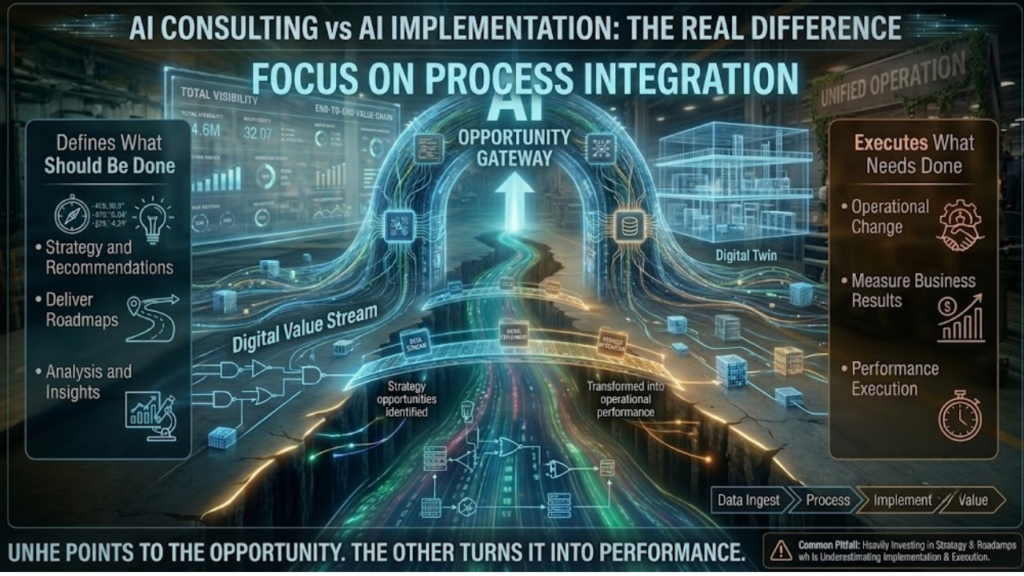
The difference is straightforward.
AI Consulting
- Defines what should be done
- Focuses on strategy and recommendations
- Delivers roadmaps and analysis
AI Implementation
- Executes what needs to be done
- Focuses on operational change
- Delivers measurable business results
One points to the opportunity.
The other turns it into performance.
Many organizations invest heavily in AI consulting and underestimate the execution required afterward.
What Successful Companies Do Differently
The companies that see real value from AI approach it differently.
They:
- Focus on execution, not just strategy
- Prioritize use cases tied to EBITDA
- Implement AI directly inside operations
- Integrate AI with management operating systems
- Build internal capability to sustain results
- Use a structured AI implementation roadmap to scale effectively
They do not treat AI as a side initiative.
They treat it as an operational change that must become part of how the business runs.
Real AI in Manufacturing: Where It Works
When AI is implemented properly, the impact becomes visible.
Examples include:
- Computer vision improving quality inspection
- Predictive maintenance AI reducing downtime
- AI-driven scheduling improving throughput
- Demand forecasting improving service levels
- Digital management operating systems enabling real-time decisions
These are not isolated pilots.
They are operational capabilities built into execution.
The Bottom Line
AI strategies do not fail because the ideas are bad.
They fail because implementation never fully happens.
The companies that succeed will not necessarily have the best AI strategy.
They will be the ones that implement faster, integrate deeper, and execute more consistently.
Because in the end, AI alone does not create value.
Execution does.
Q&A
Why do most AI strategies fail to deliver value in manufacturing?
Most failures happen after the strategy phase. Pilots stay isolated, systems remain disconnected, and AI never becomes part of daily operations. Without execution, adoption, and operational ownership, results stay limited.
What is the difference between AI consulting and AI implementation?
AI consulting focuses on strategy, use cases, and recommendations. AI implementation focuses on putting those solutions into operations, integrating them into workflows, and making sure teams actually use them every day.
What should an AI implementation roadmap include?
A strong roadmap should cover operational readiness, AI process mapping, deployment planning, system integration, and adoption. It should also focus on scaling successful use cases instead of stopping at pilots.
How do companies move from pilots to real operational impact?
AI has to become part of how the operation runs. That means integrating it into production workflows, assigning ownership, aligning teams, and building routines that sustain results over time.
Where does AI create the most value in manufacturing?
The strongest results usually come from practical operational use cases such as predictive maintenance AI, production scheduling, demand forecasting, and AI for manufacturing quality control. These areas directly improve performance and efficiency when implemented correctly.