
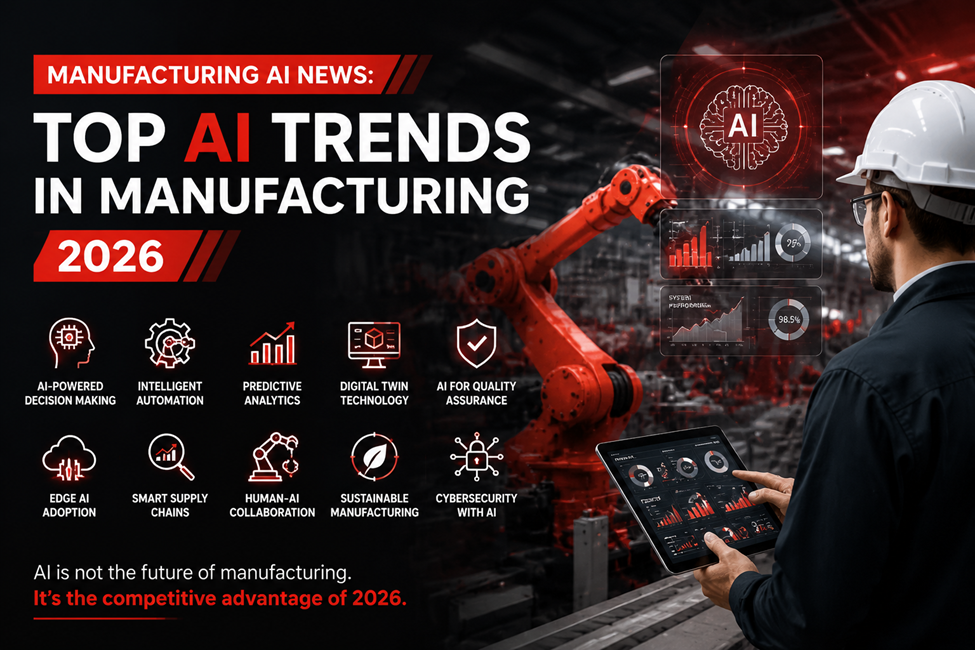
Artificial intelligence in manufacturing is rapidly transforming how factories operate, enabling smarter decision-making, automation, and real-time optimization across production systems.
Artificial intelligence is everywhere in manufacturing right now. In this AI manufacturing news snapshot for 2026, we focus on what is real, not hype.
Unlike most AI manufacturing news, which focuses on hype and future possibilities, this analysis highlights real-world AI in manufacturing trends that are already delivering measurable impact.
Every company has a roadmap.
Every executive is talking about AI.
Every vendor is promising transformation.But when you look inside operations, very little has actually changed. The gap comes down to AI implementation in manufacturing—understanding how AI is actually used in manufacturing operations, not just planned at a strategic level.
The real story in manufacturing AI is not about new technology.
It’s about practical AI implementation, where AI is actually being implemented and driving results.
To understand what’s really working, it’s important to look at AI use cases in manufacturing and real AI applications in manufacturing environments.
Here are the top AI in manufacturing trends right now based on what is working on the shop floor, not just what is being discussed in boardrooms.
1. AI Is Moving from Pilots to Full Operational Deployment
For years, AI in manufacturing lived in pilot programs.
Small proofs of concept.
Isolated use cases.
Innovation teams experimenting without impacting the core operation.
That’s changing.
The biggest shift right now is AI moving into full production environments.
For example:
- AI-driven production planning systems are now running entire plants, not just assisting planners
- Scheduling, material flow, and capacity decisions are being automated in real time
- AI is replacing manual planning processes, not augmenting them
In one case, a manufacturer deployed a plant-wide AI optimization platform that:
- Improved yield and reduced material waste
- Increased throughput using existing assets
- Eliminated dependency on manual planning decisions
These are strong examples of AI in production planning and how AI for manufacturing is moving beyond assistance into full operational control. Many organizations are also working with experienced AI consultants for manufacturing to accelerate adoption and ensure these solutions deliver measurable business value.
This is the difference between experimenting with AI and operating with AI.
2. AI Is Becoming a Core Part of Production, Not a Side Tool
Another major trend: AI is no longer sitting outside the process.
It’s being embedded directly into how production runs.
We’re seeing:
- AI controlling production variables in real time
- AI integrated into quality inspection lines
- AI driving dispatch, scheduling, and asset utilization decisions
In high-volume manufacturing environments, AI is now:
- Making decisions in milliseconds
- Operating continuously
- Running without human intervention
For example, AI-driven throughput optimization systems are:
- Increasing production output by 40%
- Reducing unplanned downtime by over 50%
This is not reporting.
This is control.
These examples show how AI in smart manufacturing is allowing production systems to become more connected, responsive, and data driven while improving operational performance.
3. Computer Vision Is Replacing Manual Quality Inspection
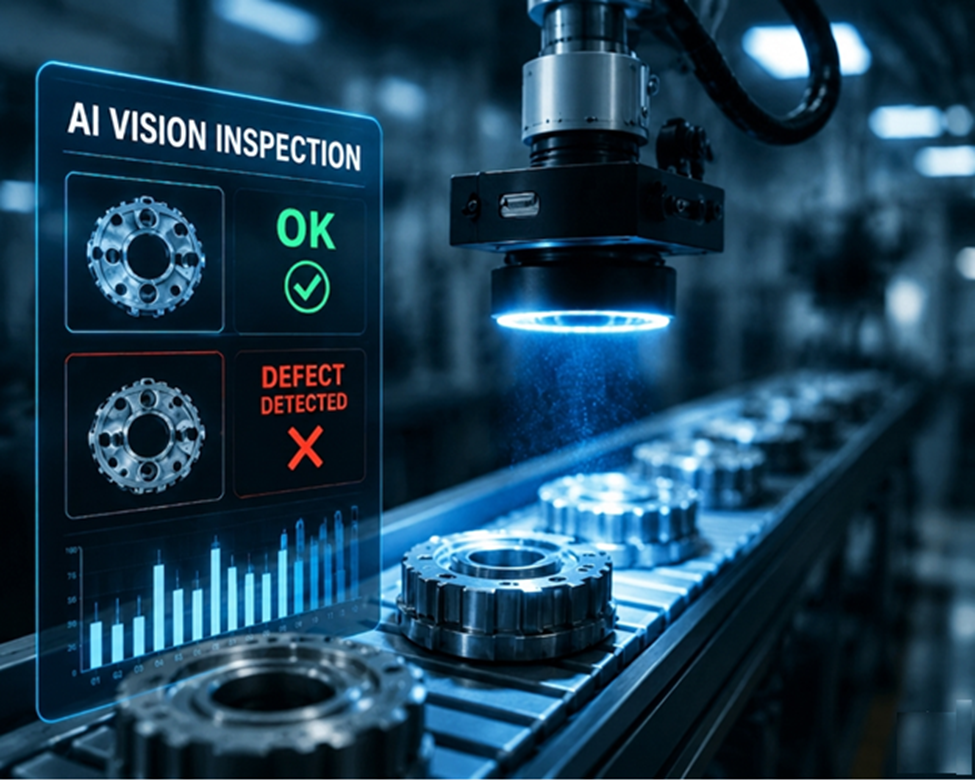
One of the fastest-growing areas of AI in manufacturing is computer vision.
And for a simple reason:
Manual inspection doesn’t scale.
Across industries, companies are replacing human inspection with AI systems that:
- Detect defects in real time
- Operate at full production speed
- Deliver consistent results across shifts
In practice, this looks like:
- Weld inspection systems identifying defects automatically
- Food processing lines detecting quality issues with near-zero error
- Medical device manufacturers inspecting microscopic defects instantly
In one example:
- Error rates dropped from ~30% to under 5%
- Quality efficiency improved by 25%
- Manual inspection was virtually eliminated
Computer vision in manufacturing is one of the most practical AI in manufacturing examples, delivering immediate ROI through improved quality and consistency. It is also one of the most widely discussed topics in recent AI manufacturing news because of its measurable impact across industries.
This trend is accelerating fast because it directly impacts:
- Yield
- Labor costs
- Customer quality
4. Predictive Maintenance Is Finally Delivering on Its Promise
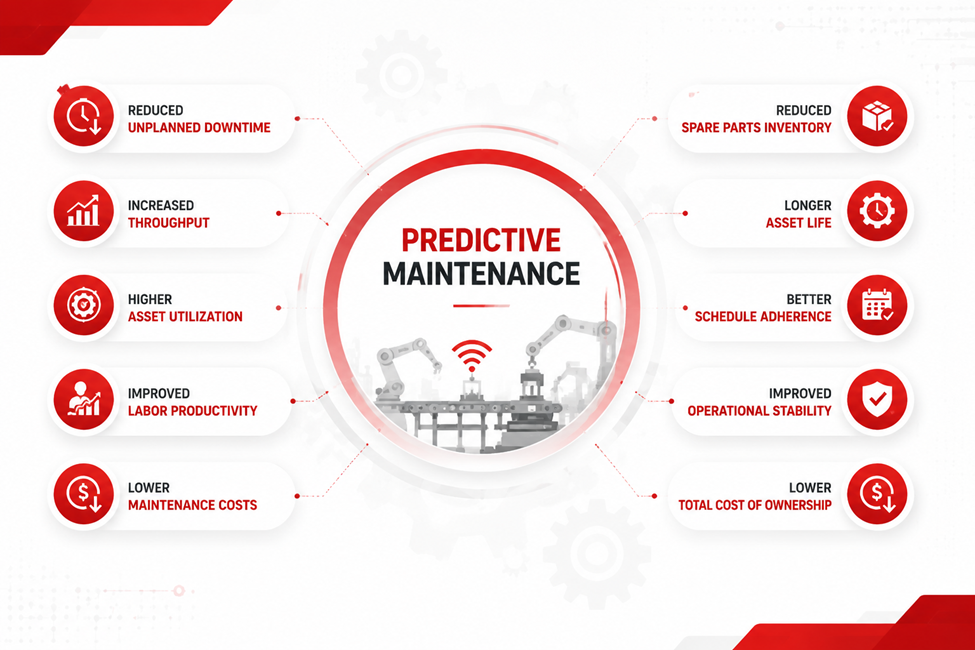
Predictive maintenance has been talked about for years.
But most implementations never moved beyond dashboards and alerts.
That’s changing.
The shift now is toward AI-driven maintenance embedded into operations:
- Continuous monitoring of equipment signals
- Real-time failure prediction
- Automated maintenance recommendations
- Integration into daily maintenance workflows
In real-world deployments:
- Unplanned downtime is reduced significantly
- Maintenance shifts from reactive to proactive
- Teams act on predicted failures, not past events
In one operation:
- Unplanned downtime was reduced by over 50%
- Production stability improved significantly
- Maintenance became a data-driven discipline
Predictive maintenance AI is now one of the most mature use cases, delivering measurable reductions in downtime and maintenance costs.
The key difference: AI is no longer just identifying issues. It’s driving action. Many manufacturers are partnering with AI consultants for manufacturing to integrate predictive maintenance into existing maintenance and reliability processes.
5. AI Is Transforming Planning and Forecasting
Planning has historically been one of the most manual areas in manufacturing.
That’s rapidly changing with AI.
We’re seeing:
- AI-driven demand forecasting models
- Real-time production planning optimization
- Integrated supply chain decision-making
Instead of relying on spreadsheets and tribal knowledge, companies are using AI to:
- Incorporate external variables (weather, economic data, demand signals)
- Continuously update forecasts
- Align production with real demand
In one case:
- Forecast accuracy improved from ~50% to 85%
- Short-term forecast accuracy reached 93%
- Planning efficiency improved by 35%
Across the AI in manufacturing industry, planning and forecasting are becoming data-driven through advanced AI systems.
This is turning planning from a guessing exercise into a data-driven system. These improvements are becoming a defining characteristic of AI in smart manufacturing, where connected systems continuously optimize production planning and resource allocation.
6. AI Is Unlocking Workforce Productivity (Not Replacing It)
There’s a lot of noise about AI replacing jobs.
That’s not what’s actually happening in manufacturing.
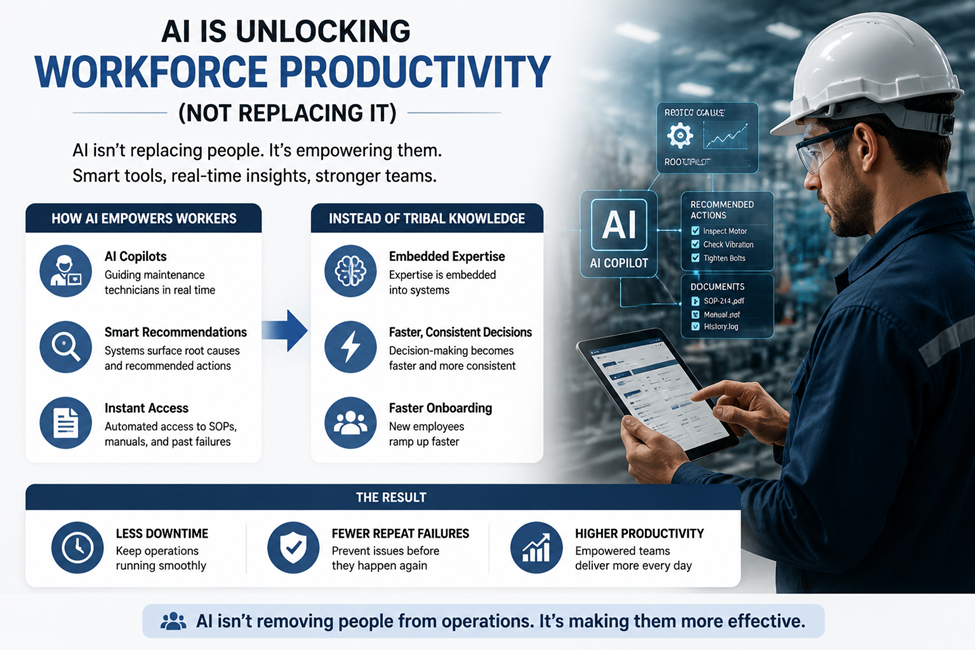
The real trend is AI augmenting and enabling the workforce.
Examples include:
- AI copilots guiding maintenance technicians
- Systems surfacing root causes and recommended actions
- Automated access to SOPs, manuals, and past failures
Instead of relying on tribal knowledge:
- Expertise is embedded into systems
- Decision-making becomes faster and more consistent
- New employees ramp up faster
The result:
- Less downtime
- Fewer repeat failures
- Higher productivity across teams
AI isn’t removing people from operations.
It’s making them more effective.
This is another area where manufacturing AI is creating measurable value by helping employees make faster decisions and improving day-to-day operational execution. Organizations often engage AI consultants for manufacturing to ensure workforce adoption keeps pace with technology implementation.
7. AI Is Moving from Insights to Decisions
This is the most important trend.
For years, AI in manufacturing focused on insights:
- Dashboards
- Reports
- Analytics
But insights don’t change operations.
Decisions do.
Today, AI is increasingly:
- Making decisions directly
- Recommending actions in real time
- Controlling processes automatically
Examples include:
- Optimizing crane dispatch across hundreds of job sites
- Balancing workforce, assets, and demand dynamically
- Automating contract validation and planning decisions
In one case:
- Planning time was reduced by 50%
- Errors dropped by 40%
- Workforce strain decreased significantly
This is the shift from visibility to control.
The overall AI impact on manufacturing is becoming clear not through strategy but through execution at scale. This shift also reflects the continued growth of AI in smart manufacturing, where intelligent systems are increasingly making operational decisions in real time.
What This Means for Manufacturing Leaders
The biggest misconception about AI in manufacturing is that it’s about technology.
It’s not.
It’s about execution.
The companies seeing real results are not the ones with the most advanced AI strategies.
They’re the ones that:
- Implement AI inside core operations
- Focus on high-impact use cases
- Integrate AI into daily workflows
- Drive adoption across teams
- Partner with top AI consulting firms or proven system integrators when appropriate
Many manufacturers also work with experienced AI consultants for manufacturing to accelerate implementation, improve adoption, and scale successful AI initiatives across multiple facilities.
AI doesn’t create value when it’s discussed.
It creates value when it’s implemented at scale.
The Bottom Line
Manufacturing AI is no longer about experimentation.
It’s about execution and AI implementation.
The trends are clear:
- AI is moving into production
- AI is embedded into operations
- AI is driving real decisions
- AI is delivering measurable impact
The question isn’t whether AI will transform manufacturing.
It’s who will implement it fast enough to gain the advantage.
The future of AI in manufacturing will not be defined by new technology but by how effectively companies execute on existing AI in manufacturing trends.
FAQS
What’s the biggest shift in manufacturing AI in 2026?
The biggest shift is AI moving from small pilots to full operational deployment. Manufacturers are now using AI to automate scheduling, material flow, capacity decisions, and planning in real time. Instead of just testing AI, plants are now operating with AI to improve yield, reduce waste, and increase throughput.
How is AI becoming a core part of production rather than a side tool?
AI is now built directly into production systems, not just used for reports or dashboards. It helps control production variables, quality inspection, scheduling, dispatch, and asset use in real time. This allows manufacturers to make faster decisions, increase output, and reduce downtime.
Why is computer vision replacing manual inspection?
Computer vision is replacing manual inspection because it detects defects in real time, works at full production speed, and delivers more consistent accuracy. Manufacturers are seeing lower error rates, better quality efficiency, reduced labor needs, and improved overall product quality.
What’s different about predictive maintenance now?
Predictive maintenance is no longer limited to dashboards and alerts. AI now monitors equipment, predicts failures in real time, and recommends maintenance actions directly inside daily workflows. This helps reduce unplanned downtime, improve production stability, and shift maintenance from reactive to proactive.
Will AI replace manufacturing jobs?
No. AI is mainly helping manufacturing workers, not replacing them. It guides technicians, suggests actions, explains root causes, and gives quick access to SOPs, manuals, and past failure data. This helps teams work faster, reduce downtime, avoid repeat issues, and improve productivity.