
Artificial intelligence is rapidly moving from experimentation to implementation across the AI in mining industry, and AI in Mining is quickly becoming mainstream. Mining companies are investing in AI to improve equipment reliability, optimize production, strengthen safety, reduce costs, and help operations make better decisions.
The opportunities are enormous. AI can help predict equipment failures before they occur optimize mine-to-mill performance via targeted mine-to-mill optimization improve ore processing streamline maintenance planning strengthen supply chain operations and provide operators with real-time decision support.
Yet many organizations find that AI initiatives struggle to move beyond pilot projects.
The reason usually is not the technology. It is the operational environment that surrounds it.
Mining companies often have no shortage of operational data. What they lack is an integrated operational foundation that allows AI to deliver reliable scalable business value.
Mining Doesn’t Have a Data Problem It Has a Connectivity Problem
Most mining operations already generate vast amounts of information. Dispatch systems track mobile equipment. Historians collect process data. Maintenance systems manage work orders. ERP platforms manage inventory and procurement. Geology systems capture ore characteristics. Laboratory systems generate quality data.
The challenge is not that these systems do not exist. The challenge is that they rarely work together.
One recent AI opportunity assessment found that many of the highest-value opportunities were not new AI models. They were opportunities to connect operational systems that already existed. Projects focused on integrating operations delay codes with maintenance work orders connecting procurement and maintenance systems improving master data and linking production quality and logistics information across the value chain.
When critical operational information remains isolated AI has only a partial view of how the business operates.
AI Doesn’t Replace Operational Decision-Making It Strengthens It
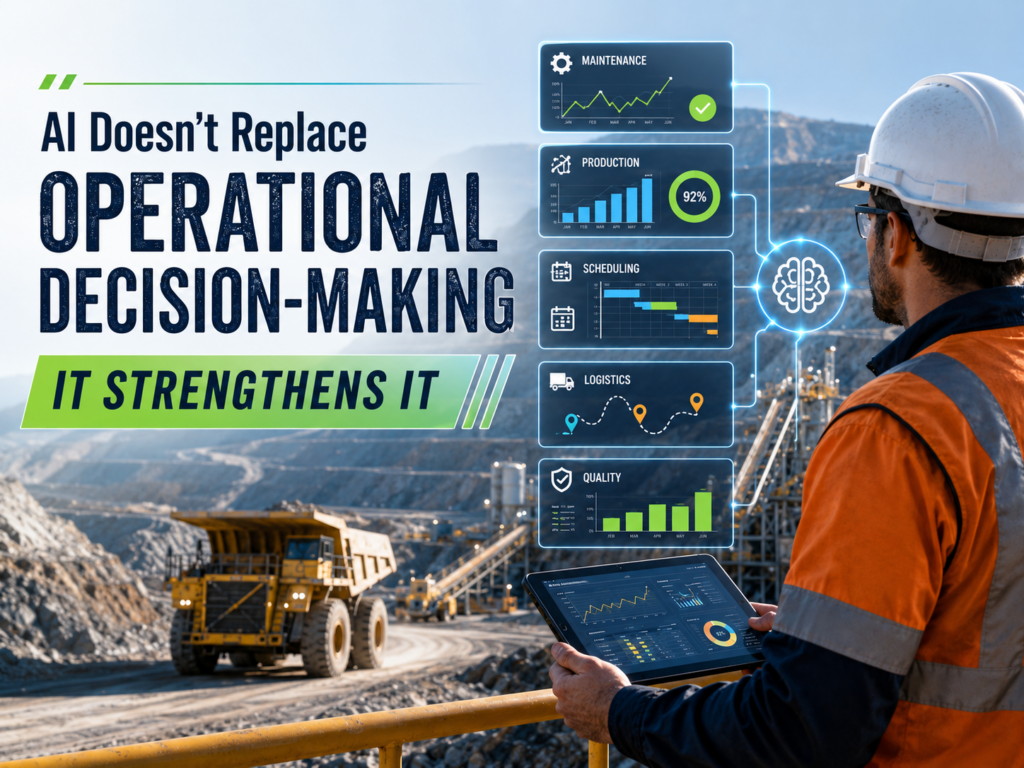
There is a common perception that AI will automate mining operations. In reality many of the most valuable applications help people make better decisions.
Across AI in mining operations, AI is increasingly supporting decisions such as:
- Which equipment requires maintenance before failure occurs
- How to optimize mine-to-mill performance
- Which ore blend will maximize downstream recovery
- How to improve production schedules
- Where logistics bottlenecks are developing
- Which quality conditions require operator intervention
Rather than replacing operators engineers planners or maintenance teams AI provides better information at the moment decisions are being made.
Predictive Maintenance Is Only One Piece of the Puzzle
Predictive maintenance receives significant attention in mining, and for good reason. Large mobile equipment, crushers, mills, conveyors, processing equipment, and rail assets all generate operational data that can be analyzed to identify developing failures before they disrupt production, forming the backbone of predictive maintenance in mining.
However successful maintenance programs extend well beyond predicting failures. Leading mining organizations are also using AI to capture technician knowledge through voice-enabled maintenance assistants accelerate root cause analysis by identifying patterns across historical failures improve maintenance planning and scheduling benchmark reliability performance across sites and support technicians with instant access to maintenance procedures and equipment history.
These applications help organizations preserve expertise while improving maintenance execution particularly as experienced workers retire and skilled labor becomes more difficult to replace.
The Greatest Opportunities Extend Across the Entire Value Chain
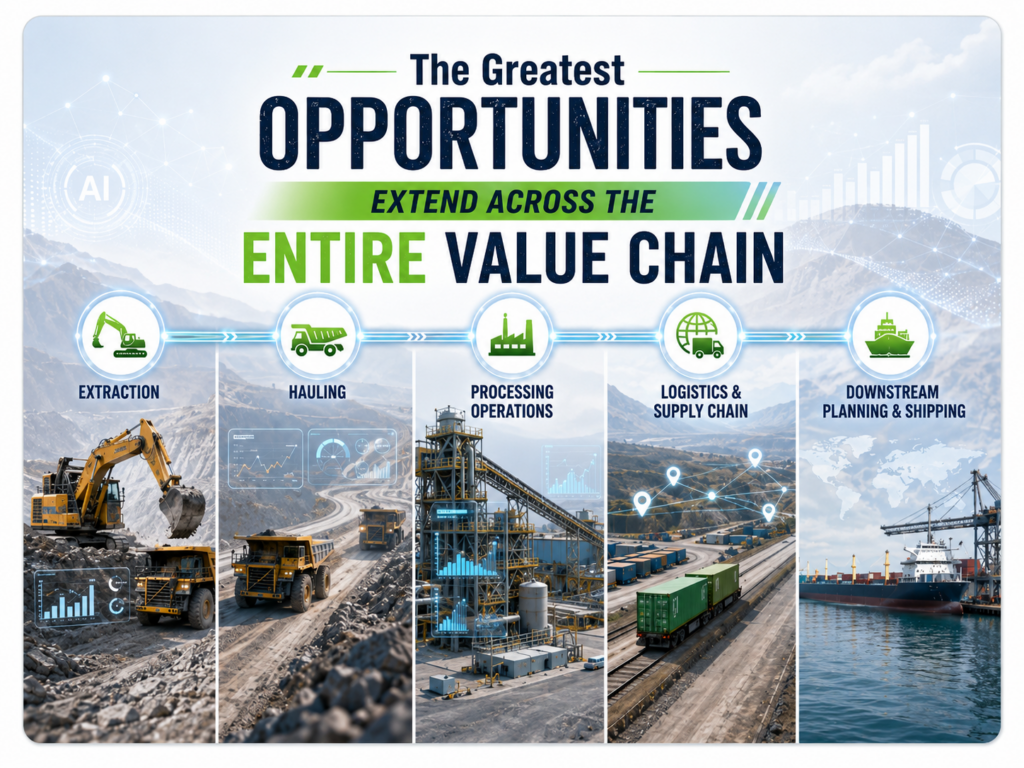
AI creates value when it improves the flow of the entire mining operation not just individual assets. Opportunities exist throughout the value stream.
In extraction and primary processing AI can support burden mix optimization blast design haulage decisions and raw material management. In processing operations AI can improve furnace performance optimize chemistry predict quality outcomes reduce defects and support operator decision-making. Across logistics and supply chain operations AI can optimize inventory improve warehouse management automate procurement activities and better align production schedules with shipping demand.
One recent assessment identified opportunities ranging from blast furnace optimization and hot strip mill scheduling to warehouse digital twins procurement automation inventory intelligence and cross-stage scheduling that connected production demand capacity and operational constraints across the business.
The lesson is clear. AI in mining operations should not be viewed as isolated applications. It should be viewed as an operational system.
Knowledge May Be Mining’s Most Valuable Asset
Many mining organizations are facing an equally important challenge. Experienced operators maintenance technicians and engineers possess decades of practical knowledge that often exists only in people’s heads. As retirements increase organizations risk losing that expertise.
AI offers an opportunity to preserve and share operational knowledge. Knowledge agents maintenance copilots searchable technical documentation and AI-assisted troubleshooting allow organizations to make expertise available across shifts departments and sites.
Rather than replacing experienced employees AI helps transfer their knowledge to the next generation of workers.
Better Data Creates Better Decisions
Artificial intelligence is only as effective as the information it receives. Organizations that achieve the greatest value invest first in strengthening the operational foundation beneath AI.
That includes:
- Integrating operational systems
- Improving master data quality
- Standardizing operational processes
- Connecting maintenance and production information
- Eliminating duplicate data
- Creating consistent performance metrics
Without these fundamentals, AI simply automates fragmented information. With them, it becomes a powerful decision-support capability that strengthens AI in mining operations.
AI Success Depends on Operational Readiness
Many mining companies begin their AI journey by evaluating software platforms. The organizations achieving the greatest results begin somewhere else. They evaluate operational readiness.
Questions such as these determine long-term success:
- Is operational data connected across the business?
- Can maintenance operations engineering and supply chain share trusted information?
- Are production processes standardized?
- Is knowledge documented and accessible?
- Are teams prepared to incorporate AI into daily decision-making?
Many organizations partner with an experienced mining consultant or mining consultancy to accelerate readiness assessments, data integration, and change management.
Technology implementation is only one step. Operational integration is what determines whether AI becomes part of everyday mining operations.
Final Thoughts
Artificial intelligence is creating tremendous opportunities across the AI in mining industry, but successful implementation depends on much more than advanced algorithms.
Organizations that realize measurable value are building integrated operational systems where production, maintenance, engineering, logistics, and supply chain information work together to support faster, better decisions.
The future of AI in Mining is not simply about automation. It is about creating connected operations where people have the information they need to improve safety, increase reliability, optimize production, and make better decisions every day.
Companies that focus on building that operational foundation, often with guidance from an experienced mining consultant, will be the ones that capture the greatest value from AI over the coming decade. Predictive maintenance in mining will continue to be one of the most impactful applications built on that foundation.
FAQs
Why do many AI initiatives in mining stall after pilots?
The main barrier is operational readiness. AI amplifies the environment it enters. When processes are fragmented and data is inconsistent AI exposes long-standing issues instead of delivering value.
What is a data foundation for AI and why is more data not enough?
A data foundation means common schemas clear lineage governance and integration so information is trusted and reusable. The problem is not lack of data but inconsistent formats and ownership that make data hard to use.
Where is the most immediate value of AI in mining today?
Making knowledge accessible. AI search lets users ask natural language questions and get cited answers in seconds reducing time spent searching through documents and notebooks.
Is predictive maintenance enough or what else should maintenance teams do with AI?
Predictive maintenance is important but only one part. Leading teams also use AI to capture technician knowledge accelerate root cause analysis improve planning and give instant access to procedures and history.
What sequence should mining companies follow for successful AI?
Start by building the operating environment AI will support including structured data standardized processes governance system integration and a phased roadmap. Many organizations work with experienced mining consultants to accelerate this work.