
Introduction
As aerospace and defense manufacturers increase production to meet growing commercial and defense demand, much of the industry’s attention has focused on expanding internal manufacturing capacity.
Organizations are investing in new equipment, hiring additional employees, expanding facilities, and increasing automation. Yet many production ramps continue to fall behind schedule.
Why?
Because increasing production isn’t solely an internal challenge. Your production rate is only as strong as your suppliers’ ability to support it.
For many aerospace manufacturers, the greatest risk isn’t inside their own facilities—it’s hidden throughout the aerospace supply chain.
Successful ramp-to-rate initiatives require more than supplier performance monitoring. They require supplier capacity validation. Formalizing a Supplier Capacity Assessment helps structure that validation while supporting better supplier capacity planning across the supply network.
Capacity Is More Than Available Machine Hours
When organizations think about supplier capacity, they often ask a simple question:
“Can the supplier produce more parts?”
That’s an important question—but it’s incomplete.
A supplier may have available machine capacity while lacking the organizational capability to successfully support higher production rates.
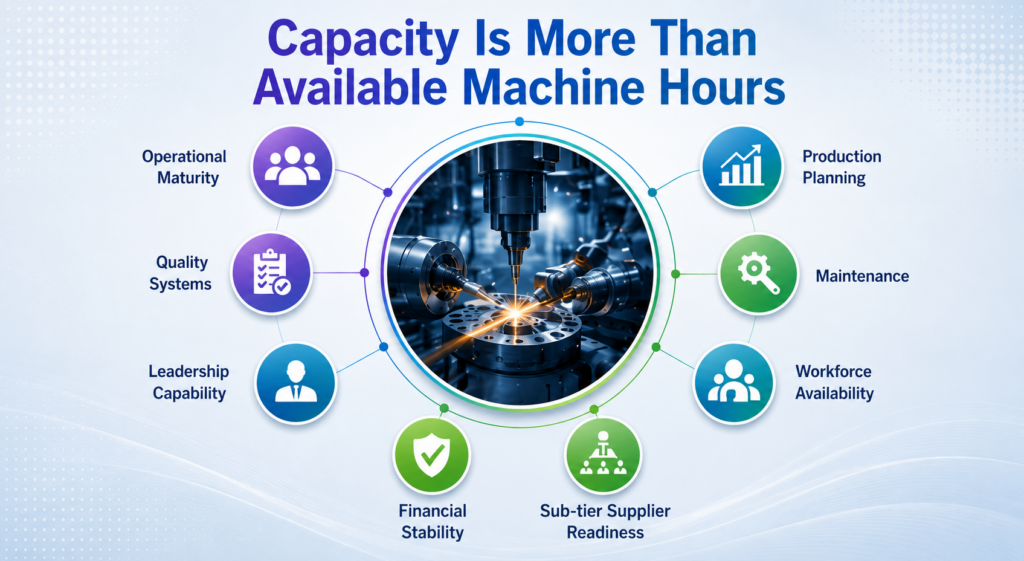
True supplier capacity includes:
• Operational maturity
• Quality systems
• Leadership capability
• Financial stability
• Sub-tier supplier readiness
• Production planning
• Maintenance
• Workforce availability
• The ability to execute consistently as demand increases
Ignoring these factors can create significant risk during a production ramp and weaken long-term supplier capacity management efforts.
Why Traditional Supplier Assessments Fall Short
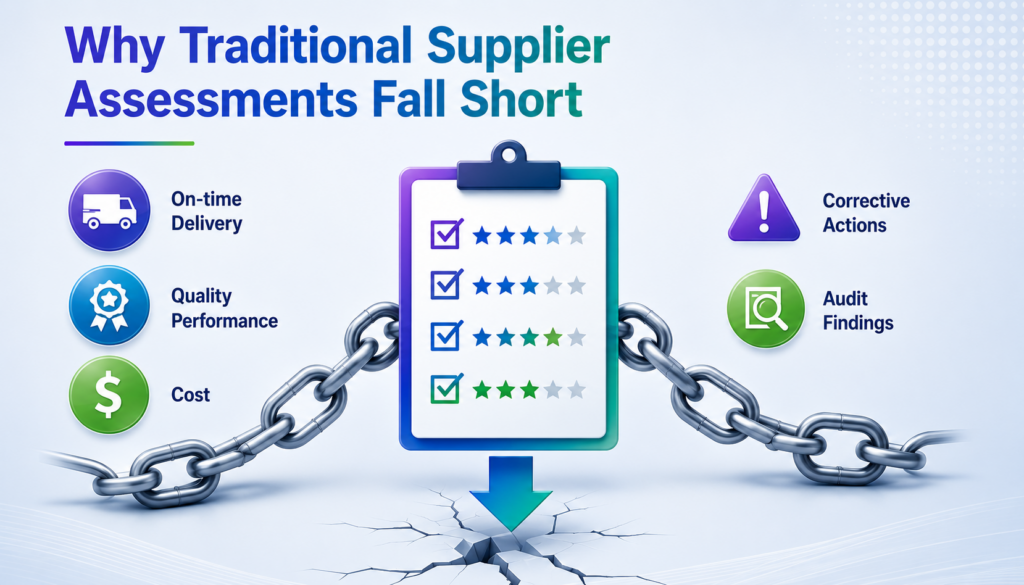
Many supplier assessments focus primarily on historical performance.
Common metrics include:
• On-time delivery
• Quality performance
• Cost
• Corrective actions
• Audit findings
These indicators provide valuable information about past performance. However, they do not necessarily predict whether a supplier can successfully support future production growth.
A supplier delivering 98% on-time performance today may still struggle during a rapid production increase if planning systems, workforce capability, production scheduling, or sub-tier suppliers cannot scale alongside demand.
Production ramps expose weaknesses that normal operating conditions often conceal. This is why organizations increasingly combine historical reviews with a comprehensive supplier capability assessment.
Supplier Capacity Assessment for Aerospace Ramp-Up Success (Part 2)
The Hidden Risks Behind Aerospace Production Ramps
As production volumes increase, supplier challenges become increasingly interconnected.
A typical chain reaction looks like this:
1. One delayed raw material shipment creates schedule changes.
2. Schedule changes increase overtime.
3. Overtime contributes to quality variation.
4. Quality issues reduce available capacity.
5. Capacity constraints delay customer deliveries.
6. The problem quickly extends beyond a single supplier and affects the entire production network.
Recent aerospace ramp planning engagements—and widely reported aerospace supply chain news—have shown that successful production increases depend on understanding not only supplier manufacturing capacity but also organizational readiness to manage growth.
This includes evaluating sub-tier supplier management, operational processes, organizational dynamics, quality systems, asset management practices, and the supplier’s ability to invest in supporting future demand through better supplier capacity analysis.
What Supplier Capacity Validation Should Evaluate
Effective supplier capacity validation looks beyond production output to evaluate the systems supporting long-term performance.
Production Capacity
Evaluate whether:
• Existing manufacturing processes can support projected demand.
• Bottleneck operations are understood.
• Sufficient equipment is available.
• Additional capacity can realistically be achieved.
Production Planning
Determine whether:
• Production schedules remain stable as demand increases.
• Priorities are managed effectively.
• Scheduling decisions are proactive rather than reactive.
• Planning processes can support multiple concurrent programs.
Strong supplier capacity planning helps manufacturers respond more effectively to changing production requirements.
Quality Systems
Higher production rates place greater pressure on quality systems.
Organizations should evaluate:
• Process control
• Standard work
• Inspection capability
• Corrective action processes
• First-pass yield
• Change management
Quality instability quickly becomes a capacity constraint during production ramps.
Sub-Tier Supplier Management
A supplier’s capacity often depends on the readiness of its own suppliers.
Organizations should understand:
• Critical material availability
• Single-source dependencies
• Long-lead components
• Supplier visibility
• Risk mitigation strategies
Robust sub-tier supplier management practices improve visibility and resilience during a ramp. Problems several tiers upstream frequently become visible only after production schedules begin slipping.
Organizational Capability
One of the most overlooked aspects of supplier readiness is organizational maturity.
Consider:
• Can leadership manage rapid growth?
• Are responsibilities clearly defined?
• Are performance metrics visible?
• Do management routines identify constraints quickly?
• Does the organization have the discipline to execute consistently under increasing production pressure?
These operational characteristics often determine whether suppliers succeed during a production ramp and are an essential part of any supplier capability assessment.
Building Risk Mitigation Before Problems Occur
Supplier capacity validation should not end with an assessment report. Its value comes from identifying risks early enough to address them.
Rather than simply documenting current conditions, leading aerospace manufacturers work collaboratively with suppliers to develop practical improvement plans.
These often include:
• Capacity improvement initiatives
• Equipment investment planning
• Workforce development
• Production planning improvements
• Quality system enhancements
• Maintenance improvements
• Supply chain risk mitigation
• Leadership and governance improvements
Some organizations supplement internal efforts with aerospace consulting support to accelerate execution and sustain results.
The objective is to strengthen supplier capability before production demand exceeds operational capacity while improving supplier capacity management across the supply chain.
Collaboration Creates Better Outcomes Than Compliance
Supplier capacity validation should not be viewed as an audit. The most successful aerospace manufacturers approach it as a collaborative effort.
Transparency allows suppliers and customers to identify risks together, establish realistic production expectations, and develop improvement plans that benefit both organizations.
This collaborative approach builds trust while creating production plans that are more achievable and sustainable than those based solely on contractual commitments or historical performance. Recent aerospace engagements have emphasized early alignment between OEMs and suppliers to create “win-win” scenarios that improve transparency, strengthen relationships, and support realistic ramp planning.
Preparing the Entire Aerospace Supply Chain for Growth
Production ramp-ups are among the most complex operational challenges facing aerospace and defense manufacturers.
Success depends on far more than expanding internal capacity.
Manufacturers must understand whether suppliers—and their suppliers—have the operational capability to support higher production rates without sacrificing quality, delivery performance, or financial stability.
Supplier capacity validation provides that visibility. It enables organizations to identify constraints before they affect production, reduce supply chain risk, and build stronger partnerships across the value stream using structured supplier capacity analysis.
As aerospace production continues to accelerate, the companies that succeed will not necessarily be those with the largest factories.
They will be the ones with the strongest, most resilient supply networks built on operational readiness, collaboration, disciplined execution, and an effective Supplier Capacity Assessment.They will be the ones with the strongest, most resilient supply networks—built on operational readiness, collaboration, and disciplined execution.
Frequently Asked Questions
Why do production ramps fall behind even after investing in internal capacity?
Because ramp success depends on the full supply network, not just internal operations. Even with new equipment, staff, or automation, weak supplier planning, quality gaps, sub-tier bottlenecks, and leadership issues can slow production and cause schedules to slip.
What is supplier capacity validation, and how is it different from traditional supplier assessments?
Supplier capacity validation checks whether a supplier can support future production growth, not just past performance. Unlike traditional assessments, it reviews capacity, planning, quality systems, workforce, sub-tier suppliers, asset management, organizational maturity, and financial readiness.
What factors define true supplier capacity beyond machine hours?
True capacity includes operational maturity, leadership capability, quality systems, production planning, sub-tier supplier readiness, asset management, workforce availability, financial stability, and the discipline to execute consistently as demand increases.
How do risks compound during a ramp, and why are they hard to see upfront?
As volumes rise, issues become interconnected: delayed materials affect schedules, schedules increase overtime, overtime impacts quality, quality reduces capacity, and capacity delays deliveries. Many of these weaknesses remain hidden until production volumes increase.
What should organizations do after completing a supplier capacity assessment?
Move from findings to action through collaborative improvement plans covering capacity investments, workforce development, production planning, quality systems, maintenance, sub-tier risk mitigation, and leadership improvements. Treat the process as collaboration—not an audit—to build transparency and resilient production plans.