
Aerospace manufacturing is under more pressure than ever.
Production rates are increasing. Backlogs are growing. Supply chains remain unstable. Expectations for quality and compliance keep rising. These challenges only intensify as programs scale and complexity increases across the aerospace manufacturing industry.
Most organizations already have a strategy to deal with this.
The real challenge is executing it.
Across aerospace and defense, the gap between plan and performance is where cost, delays, and risk show up. Many organizations are turning to aerospace consulting partners to strengthen operational execution and improve long term performance.
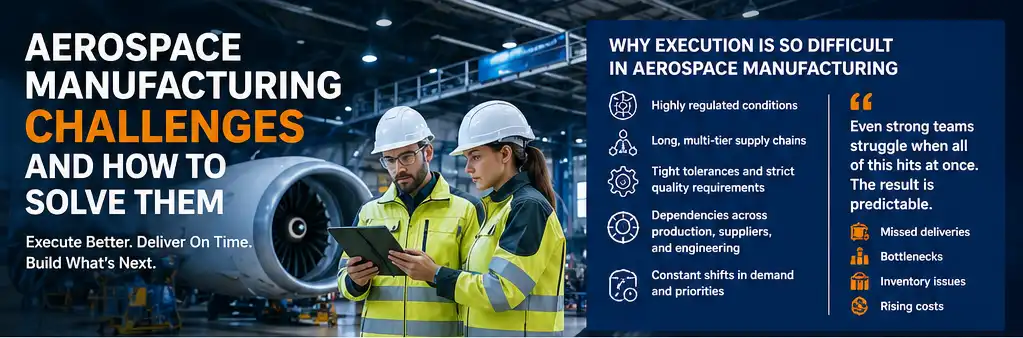
Why Execution Is So Difficult in Aerospace Manufacturing
Execution issues in aerospace are not about lack of expertise. They come from the environment itself.
- Highly regulated conditions
- Long, multi-tier supply chains
- Tight tolerances and strict quality requirements
- Dependencies across production, suppliers, and engineering
- Constant shifts in demand and priorities
Even strong teams struggle when all of this hits at once.
The result is predictable. Missed deliveries, bottlenecks, inventory issues, and rising costs during ramp-ups.
Fixing this does not require more strategy. It requires better execution supported by proven aerospace manufacturing solutions.
The Most Common Execution Challenges in Aerospace Manufacturing
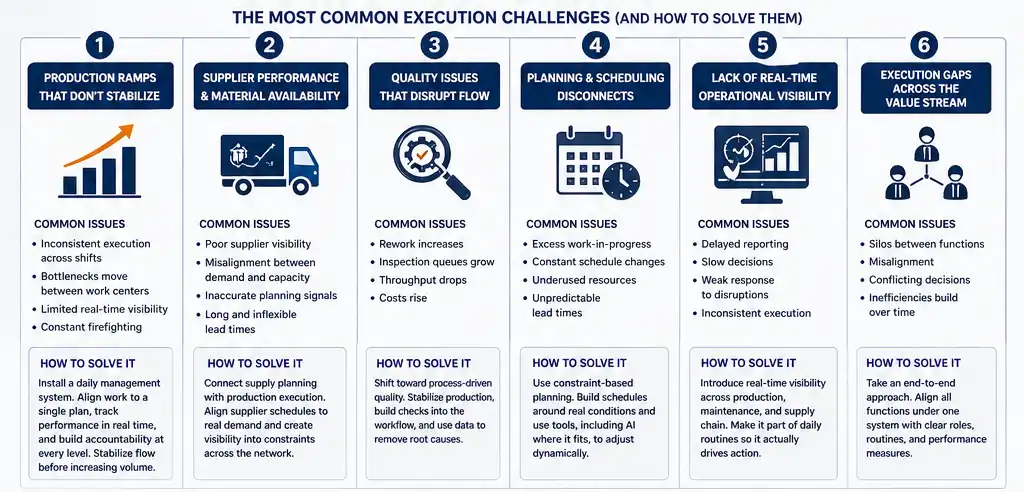
1. Production Ramps That Don’t Stabilize
Ramping production looks simple on paper. In reality, output rarely matches plan.
Common issues include inconsistent execution across shifts, bottlenecks moving between work centers, limited visibility into real-time performance, and constant firefighting.
Without stability, adding volume only adds pressure to aerospace production
How to solve it
Install a daily management system. Align work to a single plan, track performance in real time, and build accountability at every level. Stabilize flow before increasing volume.
2. Supplier Performance and Material Availability
Aerospace supply chains are tightly connected. One delay can disrupt everything.
Typical challenges:
- Poor supplier visibility
- Misalignment between demand and capacity
- Inaccurate planning signals
- Long and inflexible lead times
This leads to expediting, excess inventory, and missed commitments.
How to solve it
Connect supply planning with production execution. Align supplier schedules to real demand and create visibility into constraints across the network. This approach strengthens the overall aerospace manufacturing industry by improving coordination across suppliers and manufacturers.
3. Quality Issues That Disrupt Flow
Quality is critical, but it can also slow everything down when handled reactively.
When control is weak:
- Rework increases
- Inspection queues grow
- Throughput drops
- Costs rise
Many teams rely too much on inspection instead of prevention.
How to solve it
Shift toward process-driven quality. Stabilize production, build checks into the workflow, and use data to remove root causes. Many aerospace consulting engagements focus on improving quality systems while reducing operational disruption.
4. Planning and Scheduling Disconnects
In many environments, plans do not match reality on the shop floor.
This creates excess work-in-progress, constant schedule changes, underused resources, and unpredictable lead times.
Schedulers spend more time reacting than improving.
How to solve it
Use constraint-based planning. Build schedules around real conditions and use tools, including AI where it fits, to adjust dynamically. This improves aerospace production by helping manufacturers respond faster to changing operational conditions.
5. Lack of Real-Time Operational Visibility
Many teams still rely on delayed reporting.
By the time issues show up, the damage is already done.
This leads to slow decisions, weak response to disruptions, and inconsistent execution across teams.
How to solve it
Introduce real-time visibility across production, maintenance, and supply chain. More importantly, make it part of daily routines so it actually drives action. These capabilities are becoming an important part of modern aerospace manufacturing solutions.
6. Execution Gaps Across the Value Stream
The biggest issue is often not within one function, but between them.
Operations, maintenance, supply chain, and quality work in silos.
This creates misalignment, conflicting decisions, and inefficiencies that build over time.
Improving one area alone rarely delivers full results.
How to solve it
Take an end-to-end approach. Align all functions under one system with clear roles, routines, and performance measures. This type of alignment is becoming a priority across the aerospace manufacturing industry.
Where AI Fits (and Where It Doesn’t)

AI is gaining attention in aerospace, but most companies struggle to scale beyond pilots.
Where it works
- Predictive maintenance to prevent failures
- Production scheduling optimization
- Demand forecasting and supplier planning
- Automated quality inspection
These technologies can significantly improve aerospace production when they are integrated into daily operational workflows.
Where it fails
- When data is not aligned to operations
- When tools are not used in daily workflows
- When ownership is unclear
AI does not fix execution on its own. It strengthens what is already working. Many organizations rely on aerospace consulting specialists to ensure AI supports operational execution rather than isolated pilot projects.
The Bottom Line
Execution is what separates performance from delay.
It affects delivery, cost, and risk more than anything else.
In aerospace, the stakes are higher:
- Delays impact contracts and trust
- Quality issues carry regulatory risk
- Cost overruns reduce profitability
The companies that succeed are not the ones with the best plans.
They are the ones that execute consistently in a complex system using scalable aerospace manufacturing solutions.
Final Thought
If ramp-ups feel unstable, suppliers are unreliable, or operations feel reactive, the issue is usually not capability.
It is execution.
Fix how the business runs day to day, and results start to follow:
- Higher throughput
- Better delivery performance
- Lower operational cost
- More predictable outcomes
That is how aerospace manufacturers move from reactive to controlled, and from constrained to scalable.