
Industrial maintenance programs frequently treat preventive maintenance and predictive maintenance as competing operating philosophies. Facilities debate whether to invest in fixed-interval component replacements or pivot entirely toward advanced sensor monitoring.
That comparison sets up a false trade-off. Pitting these two approaches against each other misinterprets how equipment fails.
Achieving Asset Performance Excellence and sustained EBITDA growth requires an integrated strategy. Preventive maintenance prevents catastrophic end-of-life failures through structured frequency, while predictive maintenance catches early-stage degradation long before it causes unplanned downtime.
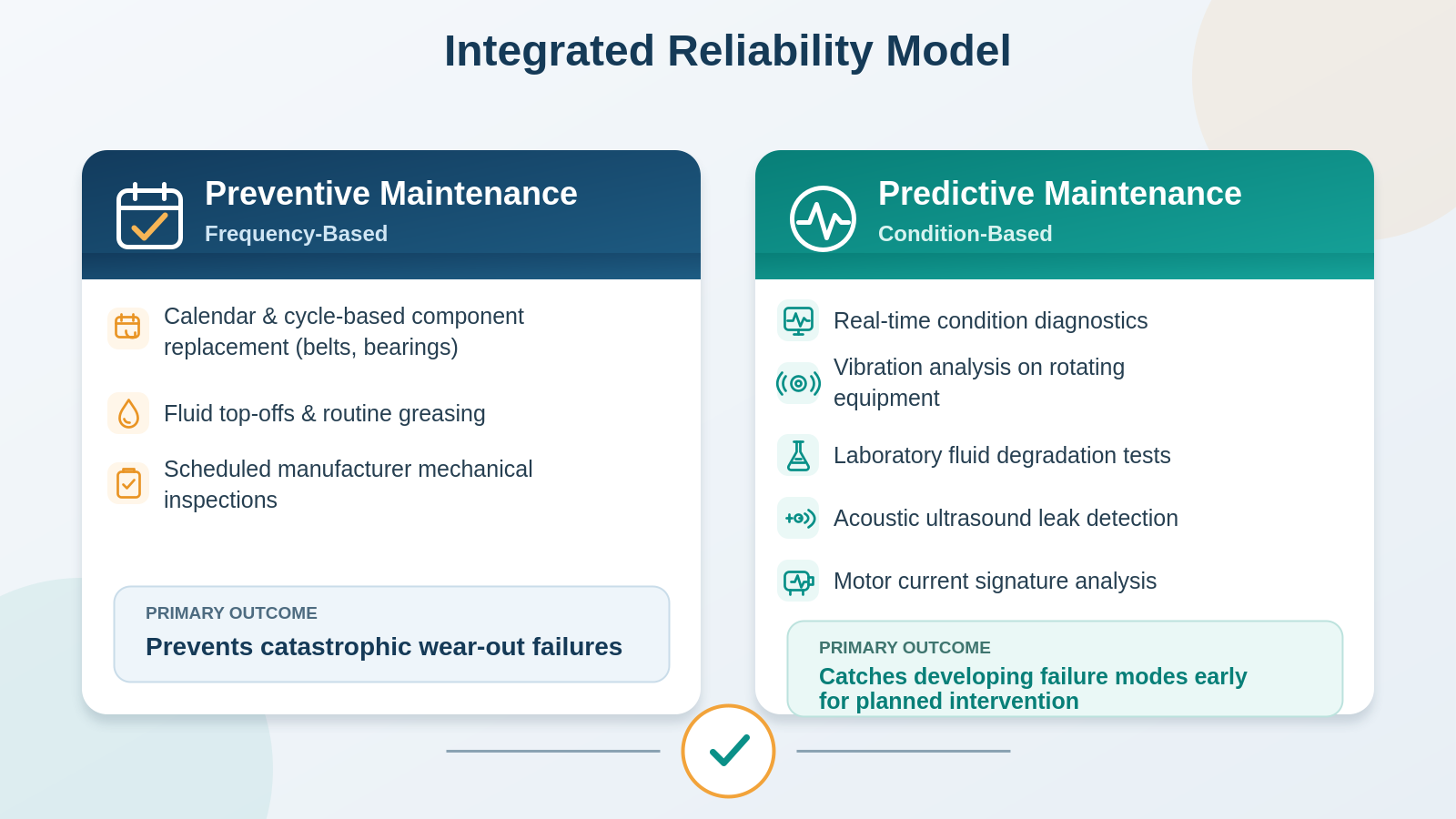
Integrated Reliability Model
| Preventive Maintenance (Frequency-Based) | Predictive Maintenance (Condition-Based) |
|---|---|
| • Calendar & cycle-based component replacement (belts, bearings) • Fluid top-offs & routine greasing • Scheduled manufacturer mechanical inspections | • Real-time condition diagnostics • Vibration analysis on rotating equipment • Laboratory fluid degradation tests • Acoustic ultrasound leak detection • Motor current signature analysis |
| ↓ | ↓ |
| Prevents catastrophic wear-out failures | Catches developing failure modes early for planned intervention |
Preventive Maintenance: Frequency-Based Protection
Preventive maintenance (PM) relies on operating history, run hours, or calendar intervals to govern component intervention. By scheduling maintenance before an asset reaches its statistical end of life, operations mitigate the risk of severe mechanical breakdown.

In practice, standard PM tasks include:
- Fixed-interval replacements: Changing drive belts every three months, swapping motor bearings annually, or replacing fleet tires on set usage intervals.
- Routine lubrication management: Executing regular lubrication rounds to top off oil levels in gearboxes, check hydraulic units, and grease mechanical bearings.
- Scheduled machine inspections: Conducting weekly, monthly, or semi-annual physical inspections aligned with original equipment manufacturer (OEM) guidelines.
During scheduled inspections, technicians identify components that are already worn or damaged. Operations leaders can then evaluate whether to address the issue immediately or schedule the repair within days to avoid a wider failure. Frequency-based maintenance establishes mechanical baseline stability, but it carries a distinct limitation: it replaces parts on schedule regardless of whether an asset still has usable operating life.
Predictive Maintenance: Condition-Driven Early Intervention
Predictive maintenance (PdM) addresses the limitations of interval replacements by evaluating the real-time physical condition of operating assets. Rather than discarding a bearing that remains structurally sound after twelve months, PdM monitors operating parameters to determine exact remaining life.
By tracking component behavior during live operation, teams capture developing failure modes at their earliest stages. This shifts maintenance from reactive firefighting into planned, executable work. Planners can order parts, assign labor, and schedule downtime well before component wear degrades production.
The Diagnostic Toolkit in Practice
PdM relies on measurable condition monitoring tools to provide objective operational data across plant assets:

| Diagnostic Technology | Primary Application | Operational Target |
| Vibration Analysis | Rotating machinery and mechanical bearings | Detects harmonic anomalies and baseline threshold breaches to signal early mechanical wear. |
| Laboratory Oil Sampling | Gearboxes and heavy hydraulic systems | Analyzes fluid contamination and chemical degradation monthly instead of swapping oil on raw calendar intervals. |
| Acoustic Ultrasound | Compressed air distribution and bearing housings | Identifies high-pressure pneumatic leaks and micro-friction across mechanical assemblies. |
| Motor Current Signature Analysis | Electrical drive motors | Identifies internal electrical winding faults and anomalies before motor failure causes line stoppage. |
Applying these diagnostics allows maintenance teams to base rebuilds, fluid changes, and component replacements on verified operating condition rather than assumed run times.
Integrating Both Disciplines to Maximize Operational Uptime
Operating a reliable plant does not mean choosing between calendars and sensors. A plant relying solely on calendar replacements risks throwing away usable parts and remains blind to sudden anomalies between service cycles. Conversely, an operation relying solely on predictive sensors without disciplined lubrication, basic cleaning, and regular physical inspections will suffer baseline mechanical decay.
To capture measurable business outcomes and eliminate unforced downtime, plant leaders should conduct an asset audit across their facility:
- Map critical production equipment into distinct maintenance classes.
- Assign basic mechanical components and routine fluid top-offs to disciplined, interval-based PM routes.
- Deploy condition monitoring technologies—vibration, oil analysis, ultrasound, and motor signature diagnostics—on high-criticality assets.