
In many manufacturing environments, maintenance is still treated as a reactive support function.
Equipment breaks. Production stops. Maintenance responds. Operations fall behind schedule. Teams work overtime to recover. The cycle repeats.
High-performing manufacturers operate differently.
They treat maintenance and reliability as strategic drivers of operational performance, throughput stability, cost control, and long-term asset effectiveness.
The result is not just fewer breakdowns.
It is a more stable and predictable operation that consistently performs at a higher level.
The strongest maintenance and reliability programs are built around disciplined execution, proactive asset management, operational accountability, and continuous improvement.
Below are some of the most important maintenance and reliability best practices used by high-performing manufacturers today.
Shift From Reactive to Proactive Maintenance
One of the clearest differences between high-performing manufacturers and struggling operations is the percentage of planned versus reactive maintenance work.
Reactive environments spend most of their time:
- Responding to breakdowns
- Managing emergencies
- Expediting parts
- Fighting production disruptions
- Working excessive overtime
High-performing organizations focus on:
- Preventive maintenance
- Predictive maintenance
- Planned work execution
- Early defect detection
- Reliability improvement
The goal is to prevent failures before they disrupt operations.
Framing the challenge as reactive vs proactive maintenance helps teams align around prevention rather than recovery.
This shift improves:
- Asset availability
- Labor productivity
- Production stability
- Maintenance cost control
- Overall operational performance
Build Strong Maintenance Planning and Scheduling Processes
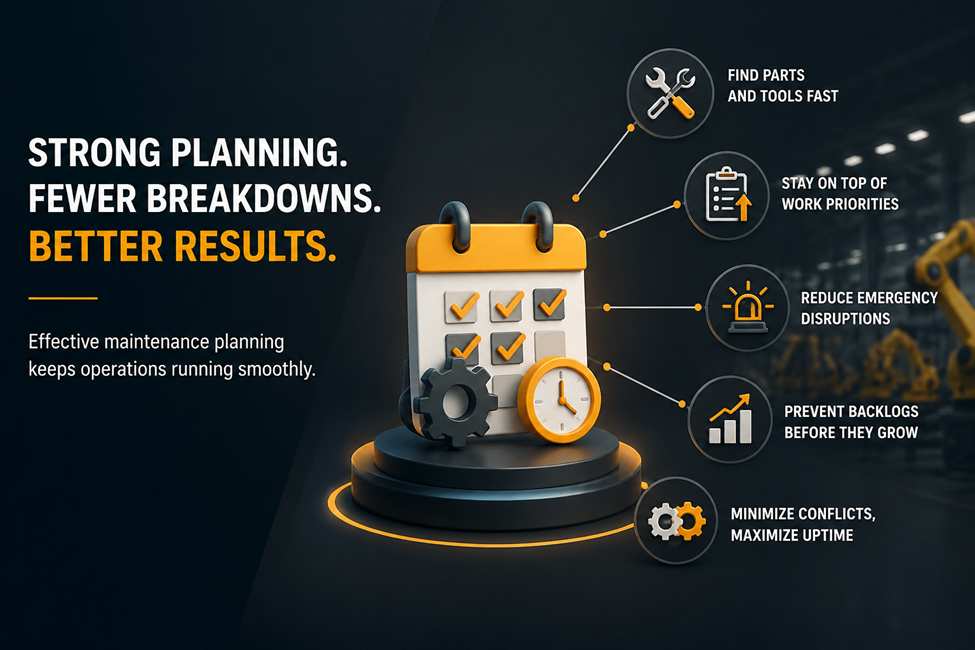
Many organizations underestimate how much maintenance inefficiency comes from weak maintenance planning and scheduling discipline.
Without structured planning and scheduling:
- Technicians lose time locating parts and tools
- Work priorities constantly shift
- Emergency jobs disrupt schedules
- Maintenance backlogs grow
- Operations and maintenance conflict increases
High-performing manufacturers implement disciplined work management processes that include:
- Weekly scheduling routines
- Maintenance planning standards
- Work prioritization systems
- Backlog management
- Clear coordination between operations and maintenance
The objective is to maximize planned maintenance execution while minimizing reactive firefighting.
In many world-class environments, more than 80% of maintenance work is planned and scheduled.
Use Predictive Maintenance to Prevent Failures Earlier
Predictive maintenance in manufacturing has become one of the most important reliability strategies for asset-intensive operations.
Instead of relying only on fixed maintenance intervals, predictive maintenance uses asset condition data to identify potential failures before breakdowns occur.
Common predictive maintenance tools include:
- Vibration analysis
- Thermography
- Oil analysis
- Ultrasound monitoring
- Motor current analysis
- AI-driven anomaly detection
The benefits of predictive maintenance in manufacturing often include:
- Reduced downtime
- Longer asset life
- Lower maintenance costs
- Improved schedule reliability
- Reduced spare parts usage
- Better maintenance labor utilization
The most successful programs integrate predictive maintenance directly into maintenance planning and operational management systems rather than treating it as a standalone technology initiative.
Implement AI for Predictive Maintenance in Manufacturing
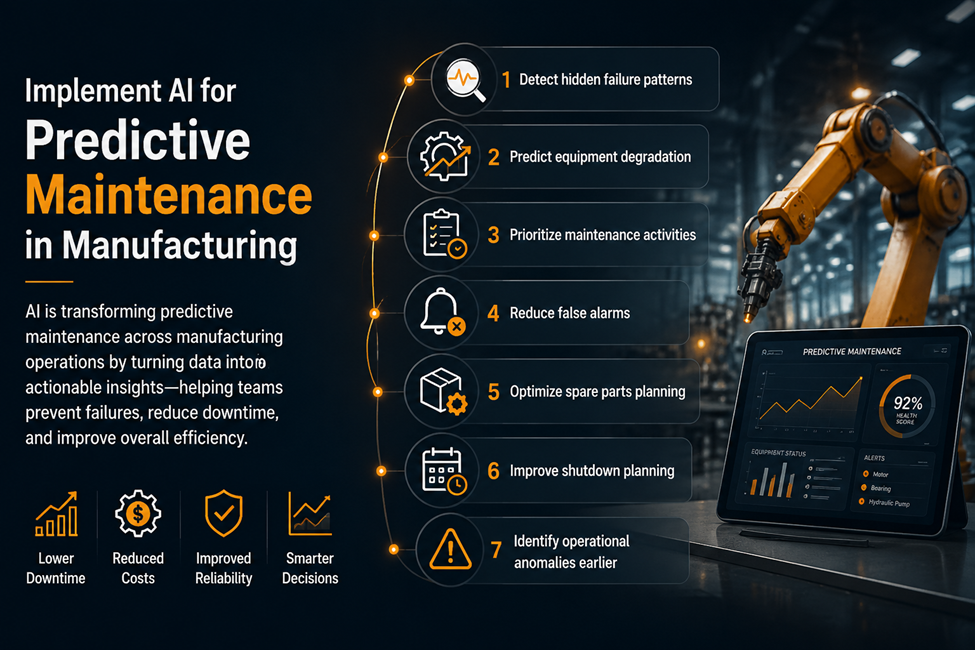
AI is increasingly improving predictive maintenance capabilities across manufacturing operations, including AI predictive maintenance use cases that learn from historical signals and operational behavior.
AI for predictive maintenance in manufacturing can help organizations:
- Detect hidden failure patterns
- Predict equipment degradation
- Prioritize maintenance activities
- Reduce false alarms
- Optimize spare parts planning
- Improve shutdown planning
- Identify operational anomalies earlier
However, high-performing manufacturers understand that AI alone does not improve reliability.
Operational execution remains critical.
The strongest implementations combine:
- AI-driven insights
- Maintenance discipline
- Real-time operational visibility
- Accountability systems
- Standardized workflows
- Management Operating Systems (MOS)
This is where predictive maintenance moves beyond dashboards and begins driving measurable operational impact.
Focus Maintenance Resources on Critical Assets
Not all assets should receive the same maintenance attention.
High-performing manufacturers prioritize equipment based on operational and business risk.
Criticality-based asset management helps organizations focus on:
- Production bottlenecks
- High-risk assets
- Safety-critical systems
- High-cost failure points
- Assets with major quality impact
This allows maintenance organizations to allocate resources more effectively and improve overall reliability performance.
Criticality assessments often become the foundation for:
- Preventive maintenance strategies
- Spare parts planning
- Predictive monitoring deployment
- Reliability engineering priorities
Standardize Root Cause Problem Solving
Repairing failures without eliminating their root causes creates recurring operational instability.
High-performing manufacturers implement structured Root Cause Analysis (RCA) processes to systematically eliminate repeat failures.
This root cause analysis maintenance approach ensures lessons translate into permanent corrective actions rather than repeated repairs.
Effective RCA programs focus on:
- Failure trends
- Chronic equipment losses
- Human factors
- Process variation
- Maintenance execution gaps
- Design weaknesses
The goal is not simply faster repairs.
The goal is reducing failure occurrence over time.
This creates long-term reliability improvement instead of repeated firefighting.
Improve Data Quality and Asset Visibility
Many maintenance organizations struggle with incomplete or unreliable maintenance data.
Poor asset data creates challenges with:
- Failure analysis
- Maintenance planning
- Inventory management
- Reliability reporting
- KPI visibility
High-performing manufacturers establish strong digital foundations through:
- Standardized asset hierarchies
- Failure code structures
- Work order data standards
- Reliability dashboards
- CMMS optimization
- Digital maintenance visibility
This creates more informed and data-driven decision making across maintenance and operations teams.
Create Shared Ownership Between Operations and Maintenance
Reliability cannot sit entirely within the maintenance department.
High-performing manufacturers create shared accountability between operations and maintenance teams.
This often includes:
- Operator care programs
- Autonomous maintenance
- Basic inspections
- Equipment cleaning standards
- Early defect detection
- Cross-functional reliability reviews
Operators become active participants in asset health rather than simply reporting failures after breakdowns occur.
This improves communication, speeds issue identification, and strengthens overall equipment ownership.
Develop a Reliability-Focused Culture
Technology and processes alone do not sustain reliability improvements.
High-performing manufacturers build cultures that reinforce:
- Precision maintenance
- Accountability
- Standardized execution
- Continuous improvement
- Problem solving
- Operational discipline
This often includes:
- Maintenance training
- Reliability leadership development
- Planner and scheduler capability building
- Standard operating procedures
- Supervisor standard work
The objective is to make proactive reliability part of everyday operational behavior.
Use a Management Operating System (MOS) to Sustain Results
Many reliability initiatives fail because improvements are never embedded into daily operational management.
A Management Operating System (MOS) helps sustain maintenance and reliability performance by creating:
- Daily KPI visibility
- Escalation management
- Accountability structures
- Tiered operational reviews
- Cross-functional coordination
- Standard leadership routines
A strong MOS ensures reliability improvement becomes part of how the business operates every day rather than a temporary initiative.
In practice, a management operating system MOS anchors the daily cadence that sustains operational gains.
Why Maintenance and Reliability Best Practices Matter
Maintenance and reliability directly impact nearly every aspect of manufacturing performance.
Poor reliability creates:
- Production instability
- Higher costs
- Missed deliveries
- Inventory growth
- Quality issues
- Overtime labor
- Safety risk
- Lower throughput
Strong reliability systems create the opposite:
- Stable operations
- Higher asset utilization
- Better schedule adherence
- Lower operating costs
- Improved customer performance
- Greater operational agility
The highest-performing manufacturers understand that reliability is not just a maintenance objective.
It is a business performance strategy.
Final Thoughts
The best maintenance and reliability programs are not built around reacting faster to failures.
They are built around preventing failures, improving operational stability, and sustaining execution discipline across the organization.
High-performing manufacturers consistently invest in:
- Predictive maintenance
- AI-enabled reliability
- Work management discipline
- Reliability engineering
- Digital visibility
- Operator ownership
- MOS implementation
- Workforce capability development
These organizations do not simply maintain equipment better.
They operate their businesses more effectively because of it.
Frequently Asked Questions
How do we know we are moving from reactive to proactive maintenance?
You are progressing when more maintenance work becomes planned and scheduled rather than emergency-driven. High-performing organizations often exceed 80% planned work execution while reducing reactive firefighting and unplanned downtime.
Why is maintenance planning and scheduling important?
Strong maintenance planning and scheduling improves labor efficiency, reduces downtime, minimizes disruptions, and helps maintenance teams execute work more consistently with fewer emergencies.
How does predictive maintenance improve reliability?
Predictive maintenance identifies potential failures before breakdowns occur using condition monitoring and operational data. This helps organizations reduce downtime, extend asset life, and improve maintenance efficiency.
What role does AI play in predictive maintenance?
AI helps detect failure patterns, prioritize maintenance activities, reduce false alarms, and improve planning decisions. However, the greatest results come when AI is integrated into operational workflows and execution systems.
Why is a Management Operating System (MOS) important for reliability?
A MOS helps sustain reliability improvements through KPI visibility, escalation workflows, accountability systems, and standardized leadership routines that embed reliability into daily operations.