

EBITDA (Earnings Before Interest, Taxes, Depreciation, and Amortization) is a key financial metric used to measure a company’s operating performance. In simple terms, EBITDA refers to profitability before non-operational and non-cash expenses are deducted.
Manufacturing companies spend millions every year on consulting and manufacturing consulting services: strategy, transformation roadmaps, digital initiatives, and cost reduction programs.
And yet, for many organizations, the results don’t show up where it matters. EBITDA doesn’t move fast enough. For most manufacturing companies, what constitutes a good EBITDA depends on whether operations fundamentally improve. Otherwise, the same problems keep recurring.
Manufacturing companies spend millions every year on consulting and manufacturing consulting services.
So the question isn’t:
So the question isn’t: Which manufacturing consulting firms should you hire?
The real question is:
What actually drives EBITDA in manufacturing?
The Reality: Consulting Doesn’t Equal Results
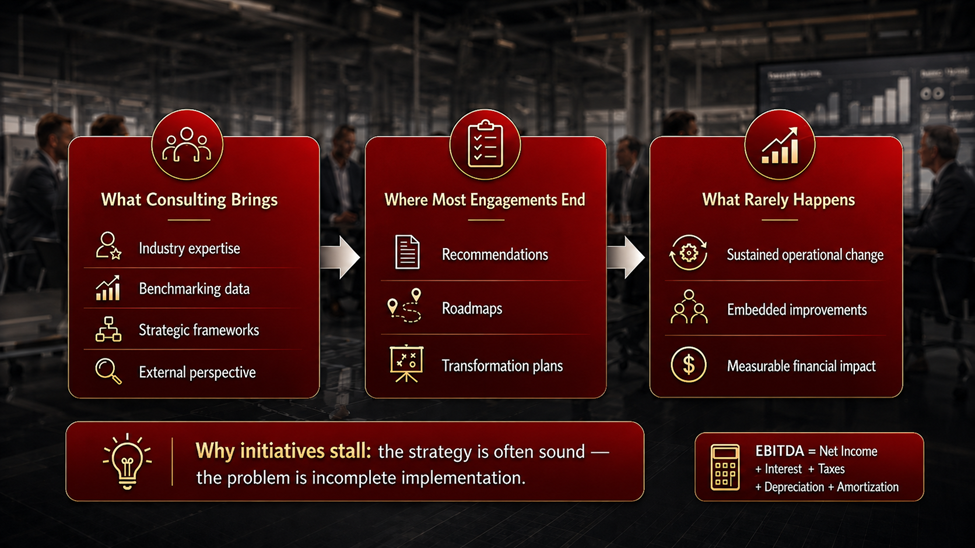
Manufacturing consulting firms play an important role. They bring:
- Industry expertise
- Benchmarking data
- Strategic frameworks
- An external perspective
But there’s a fundamental gap in the traditional model. Most consulting engagements end with:
- Recommendations
- Roadmaps
- Transformation plans
Very few engagements result in:
- Sustained operational change
- Embedded improvements
- Measurable financial impact
This gap is why so many initiatives stall. Most companies fail to realize the full value of their improvement efforts—not because the strategy is wrong, but because it is never fully implemented.
Before understanding what drives EBITDA, it’s important to know how to calculate it. EBITDA is typically calculated by adding interest, taxes, depreciation, and amortization back to net income or operating income.
What Actually Drives EBITDA in Manufacturing
If you strip away the noise, EBITDA in manufacturing is driven by a few core levers:
1. Throughput
Maximizing output from the same assets improves EBITDA directly. This comes from:
- Removing bottlenecks
- Improving flow
- Stabilizing production
- Optimizing scheduling
For example, increasing production output without increasing costs directly improves EBITDA margins and overall profitability. Real gains happen on the shop floor—not in strategy decks.
2. Cost Reduction (That Sticks)
Sustainable cost reduction is more than one-time cuts. True savings come from:
- Process improvements
- Labor productivity enhancements
- Waste elimination
- Better planning and execution
If processes don’t change, costs return. Embedding these improvements into daily routines ensures long-term EBITDA impact.
3. Asset Reliability
Unplanned downtime erodes EBITDA. Improvements come from:
- Predictive and planned maintenance
- Better maintenance execution
- Integration of maintenance into operations
Reliability is one of the fastest ways to unlock capacity without additional capital investment.
4. Quality and Yield
Scrap, rework, and defects reduce profitability. High-performing operations:
- Detect issues early
- Standardize quality processes
- Embed quality into production
AI and digital tools now significantly enhance these areas, enabling higher yield and margin preservation.
5. Planning and Supply Chain Execution
Inefficiency often begins with planning. Key improvements include:
- Accurate demand forecasting
- Integrated production planning
- Inventory optimization
- Supplier performance management
Without strong planning, operations are always reacting rather than proactively improving.
Where Most Manufacturing Consulting Firms Fall Short
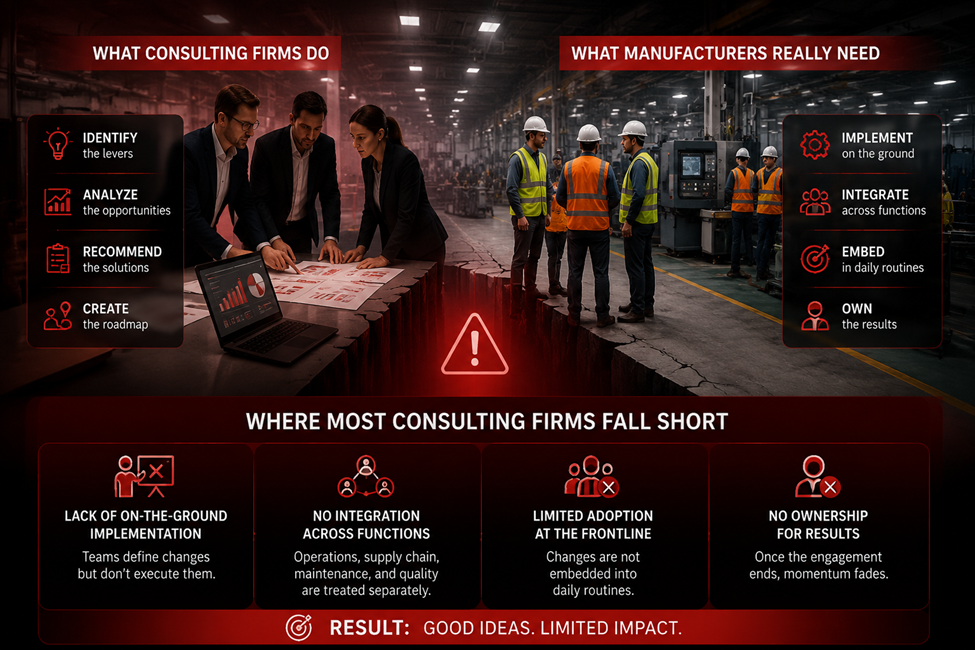
Most consulting firms can identify these levers. The real issue is execution. Common breakdowns include:
- Lack of on-the-ground implementation – Teams define changes but don’t execute them.
- No integration across functions – Operations, supply chain, maintenance, and quality are treated separately.
- Limited adoption at the frontline – Changes are not embedded into daily routines.
- No ownership for results – Once the engagement ends, momentum fades.
Result: Good ideas, limited impact.
The Shift: From Consulting to Implementation
Leading manufacturers are rethinking how they approach improvement. Instead of asking: “Who can advise us?”, they’re asking: “Who can implement inside our operation?”
Implementation-Focused Approach
- Work side-by-side with operations teams
- Focus on execution, not just analysis
- Integrate improvements across the value stream
- Embed changes into daily management systems
- Drive measurable financial results
This is where EBITDA truly moves.
The Role of AI and Digital in Modern Manufacturing Consulting
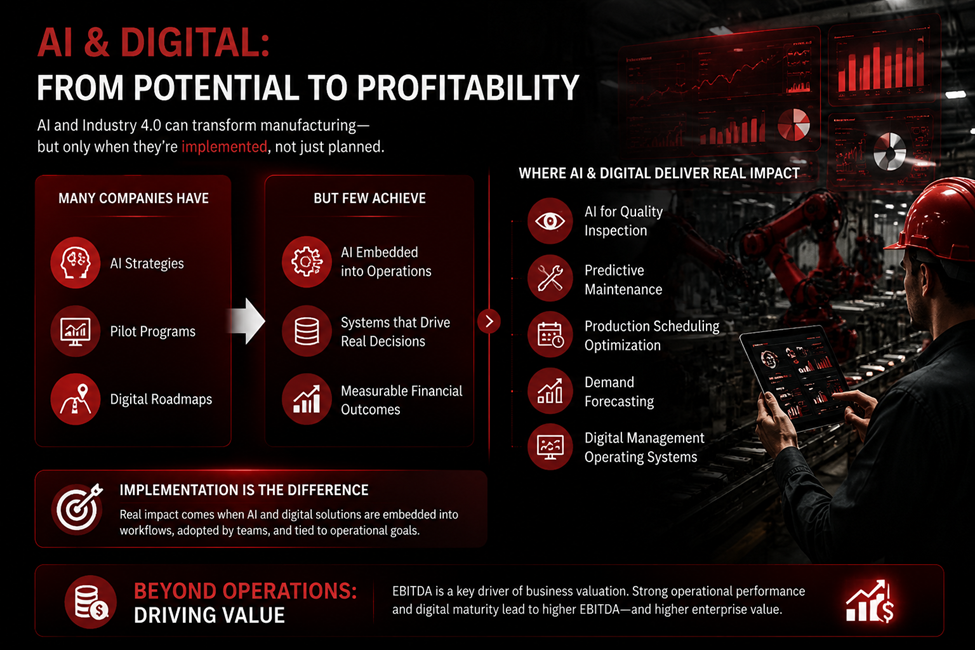
AI and Industry 4.0 are increasingly critical in manufacturing operations consulting. Yet, the challenge remains the same: many companies have AI strategies, pilot programs, and digital roadmaps but few achieve AI embedded into operations, systems that drive real decisions, and measurable financial outcomes:
- AI strategies
- Pilot programs
- Digital roadmaps
But few achieve:
- AI embedded into operations
- Systems that drive real decisions
- Measurable financial outcomes
Effective applications include:
- AI for quality inspection
- Predictive maintenance
- Production scheduling optimization
- Demand forecasting
- Digital management operating systems
But these only deliver results when implemented, not just explored.
EBITDA is also widely used in business valuation, as investors assess company performance and potential returns based on EBITDA multiples.
What to Look for in a Manufacturing Consulting Firm
If your goal is EBITDA impact, focus on manufacturing consulting firms that:
- Prioritize implementation, not just strategy – Recommendations are not enough.
- Work inside your operation – Engage with frontline teams, not just leadership.
- Drive cross-functional improvement – Operations, supply chain, maintenance, and quality together.
- Deliver measurable results – Throughput, cost, quality, reliability.
- Build sustainability – Ensure improvements last beyond the engagement.
The Bottom Line
Manufacturing consulting firms alone do not drive EBITDA. Execution does. Firms that create real value:
- Implement inside your business
- Change how operations run
- Deliver measurable outcomes
In manufacturing, strategy is only the starting point. Results come from execution.
Frequently Asked Questions
What is EBITDA and why is it important in manufacturing?
EBITDA measures a company’s core profitability, excluding non-operational expenses. In manufacturing, it highlights operational efficiency, allowing comparisons across companies and industries without the impact of financing or accounting decisions.
How do you calculate EBITDA in manufacturing operations?
EBITDA is calculated as:
Net or operating income + Interest + Taxes + Depreciation + Amortization
For example, a plant with $10M in operating income, $1M in depreciation, and $500K in amortization would have an EBITDA of $11.5M.
What factors impact EBITDA margin in production environments?
Throughput, cost efficiency, asset reliability, quality, and planning effectiveness. Enhancing output, reducing waste, minimizing downtime, and optimizing scheduling all boost EBITDA. AI and digital tools can further strengthen performance.
Why doesn’t hiring a top manufacturing consulting firm automatically improve EBITDA?
Without sustained changes, cross-functional integration, and frontline adoption, consulting recommendations alone do not translate into improved EBITDA.
What specific levers actually move EBITDA in manufacturing?
- Throughput: Remove bottlenecks, stabilize production, optimize scheduling
- Cost reduction: Improve processes, productivity, and reduce waste
- Asset reliability: Predictive maintenance and operations integration
- Quality and yield: Detect issues early, standardize, and reduce defects
- Planning and supply chain: Forecast accurately, optimize inventory, and elevate supplier performance
What causes cost reductions to fade – and how do you make them stick?
One-time cuts fade if processes don’t change. Sustainable savings come from redesigning workflows, improving planning, boosting labor productivity, and embedding changes into daily routines.
Where can AI and Industry 4.0 make a measurable difference?
When embedded into operations and decision-making: quality inspection, predictive maintenance, scheduling optimization, demand forecasting, and digital management systems. Measurable results occur only when systems are implemented and drive decisions.
What should you look for in a consulting partner if EBITDA impact is the goal?
Choose firms that:
- Focus on execution with frontline teams
- Drive cross-functional improvements
- Deliver measurable results in throughput, cost, quality, and reliability
- Ensure sustainability of improvements