
Strategy vs Execution: Why Most Companies Fail
The Gap Most Teams Feel But Cannot Fix
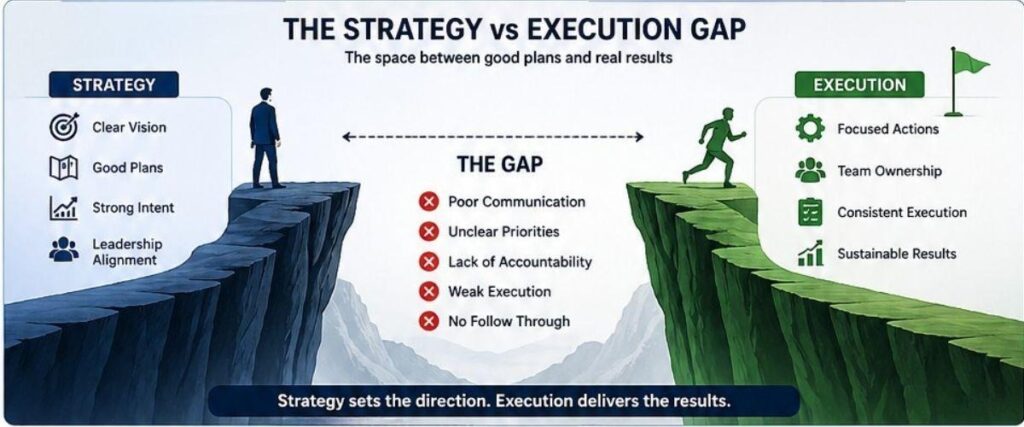
Every leadership team has a strategy. Growth plans. Cost reduction targets. Digital transformation roadmaps. AI initiatives. On paper, it all makes sense.
But in reality, most of it never delivers the value it was supposed to. That is the strategy vs execution gap. And it is not small.
Roughly 70 – 90% of strategic initiatives fail to achieve their intended results.
This is not a strategy problem.
It is an execution problem.
What Is Really Going Wrong
When performance stalls, most teams go back to strategy. More analysis. More planning. More decks. More outside advice.
But the issue is rarely knowing what to do. Most operators already know where things are breaking.
- Throughput constraints.
- Poor schedule adherence.
- High downtime.
- Inventory imbalances.
- Quality issues.
- Underutilized digital tools.
- AI pilots that never scale.
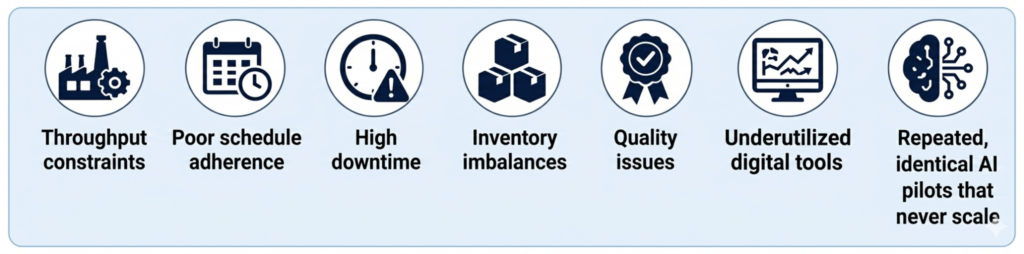
The problem is not insight.
The problem is turning that insight into consistent action and keeping it going.
Where Strategy Breaks Down
There is a clear pattern across industries.
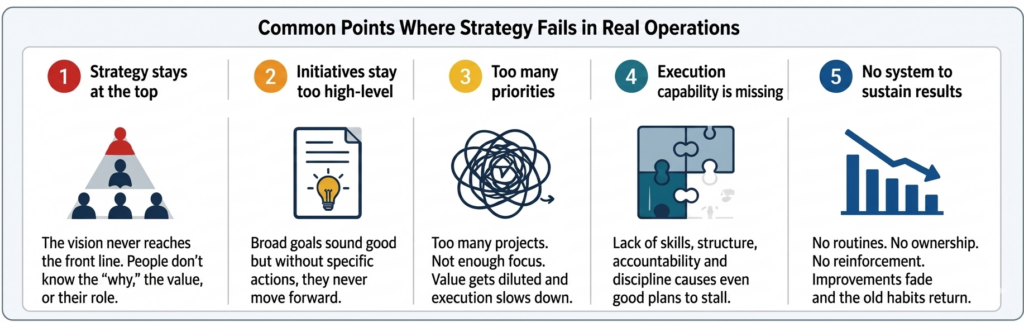
1. Strategy stays at the top
Leaders define the vision, but it never becomes real at the plant, line, or function level. People on the floor do not know
● What the strategy actually means
● What it’s worth
● What their role is in delivering it, or how their daily work helps translate strategy into action
So nothing changes.
2. Initiatives stay too high-level
Strategies are often designed as broad transformations:
- Improve supply chain
- Implement AI
- Drive operational excellence
Without breaking these into specific actions, they stay conceptual and never move.
3. Too many priorities
Too many workstreams. Too many “important” projects.
Value does not come from doing everything. It comes from a few critical changes that actually move EBITDA.
4. Execution capability is missing
Execution needs structure, discipline, accountability, skills and behavior change. Most organizations are built to operate, not transform. So even the right initiatives stall.
5. No system to sustain results
Even when improvements happen, they fade. No routines. No ownership. No reinforcement. The organization slips back.
The Reality
Strategy Only Creates Value When It’s Executed. Strategy does not create EBITDA. Execution does.
Execution is what turns ideas into actions, actions into performance and performance into financial results.
Without execution, strategy stays potential.
What Actually Works
The companies that deliver results do one thing differently.
They do not separate strategy and execution. They connect them.
Align
Make the strategy clear and visible. Translate it into operational terms. Show people what matters and why.
Design
Turn strategy into real work. Define specific initiatives. Build plans that teams can actually execute.
Execute
Implement inside the operation. Train teams. Track results. Build routines. Drive behavior change. Stay until it works.

Why This Matters Now
Every wave has promised transformation.
- Lean
- Six Sigma
- Operational Excellence
- Industry 4.0
- AI
Each one worked for companies that actually followed through. But overall, failure rates stayed the same. Because the problem never changed.
It was never vision. It was execution.
The Bottom Line
Most companies do not fail because they chose the wrong strategy. They fail because they never truly implemented it.
- Not fully
- Not deeply
- Not in a way that lasts
Execution is not the last step. It is the strategy. Mastering how to execute strategy—with a clear management operating system and frontline ownership—is why strategy succeeds, and the absence of it is why strategy fails.
Common Questions
What is the strategy vs execution gap?
It is the gap between having a clear strategy on paper and actually delivering results in operations. In most cases, the direction is not the issue. The problem is turning that direction into consistent, repeatable execution across teams.
How do we know if we have an execution problem?
You usually see it in day-to-day operations. Delays, downtime, quality issues and initiatives that never scale. The organization knows what needs to be done, but struggles to make it happen consistently on the ground.
How do we turn strategy into action?
It starts with clarity. Align people around a few priorities, turn those into specific actions and execute with ownership and follow through. Results come when teams keep working on it until it sticks.
Why do too many initiatives fail?
Because focus gets lost. When everything is treated as important, execution slows down. Real progress comes from choosing a few critical changes and seeing them through properly.
How do we make improvements stick?
Improvements last when they become part of daily work. That means clear ownership, regular tracking and simple routines that keep teams accountable over time.
Start Closing the Gap
If the strategy is clear but results are not showing, the issue is execution.
Start with a structured approach that turns strategy into real, measurable outcomes.