
How Can a Business Reduce Costs? A Practical Guide for Manufacturing Leaders
A Practical Guide for Manufacturing Leaders Focused on Real Results

Reducing costs is one of the most common priorities in manufacturing. It is also one of the most misunderstood. Most companies do not actually have a cost problem.
They have an execution problem.
Cost reduction efforts often start with the right intent. Lean programs, digital transformation, restructuring. But they stall before real impact is seen. The result is small, short-term savings or no lasting improvement at all.
If the goal is to reduce cost in a way that improves EBITDA, not just cut spend for a quarter, the approach has to change.
Summary
Sustainable cost reduction comes from fixing how the business runs every day. Not blanket cuts.
It means improving core drivers across the value stream:
- Increasing throughput without adding cost
- Reducing downtime
- Cutting scrap and rework
- Improving inventory and flow
- Fixing planning and scheduling
- Using AI where it actually changes operations
When this is done properly, costs go down, capacity opens up and results last.
Where Most Cost Reduction Efforts Fail
Many organizations start with:
- Headcount cuts
- Budget freezes
- One-time procurement savings
- High-level recommendations
These can reduce spend in the short term. But they do not fix what is actually driving cost.
In manufacturing, cost is a result of how operations run day to day.
Unplanned downtime increases overtime and lost output. Poor scheduling creates excess inventory and expediting. Quality issues drive scrap and rework. Disconnected systems slow everything down.
Until these are fixed, cost always comes back.
The Real Levers to Reduce Cost
Real cost reduction comes from improving how the business operates.
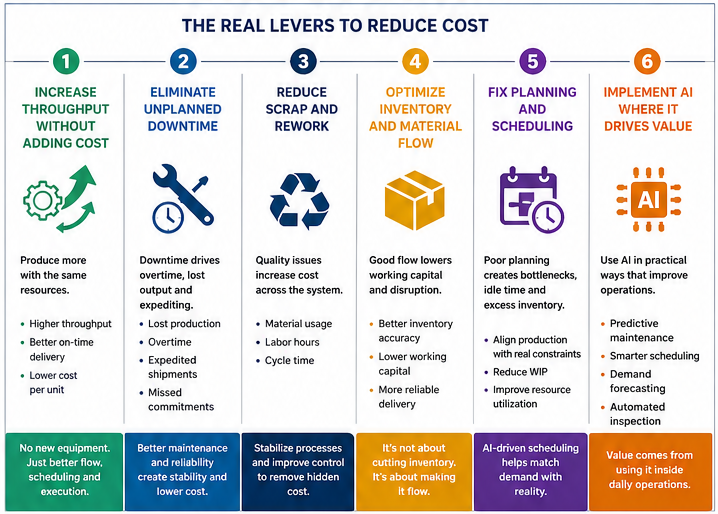
1. Increase Throughput Without Adding Cost
One of the fastest ways to reduce cost per unit is simple. Produce more with the same resources.
In one environment, stabilizing operations and removing constraints led to:
- Higher throughput
- Better on-time delivery
- Lower cost per unit
No new equipment was added. The gains came from fixing flow, scheduling and daily execution.
When output increases, fixed costs spread naturally. Unit cost drops without cutting people or adding capital.
2. Eliminate Unplanned Downtime
Downtime is often underestimated but it is one of the biggest cost drivers.
It creates:
- Lost production
- Overtime
- Expedited shipments
- Missed commitments
Organizations that improve maintenance and reliability see more stable operations, fewer breakdowns and less emergency work.
This reduces cost directly while improving performance.
3. Reduce Scrap and Rework
Quality issues quietly increase cost across the system.
They affect:
- Material usage
- Labor hours
- Cycle time
By stabilizing processes and improving control, companies remove hidden cost from daily operations.
Even small improvements in variability can significantly reduce scrap and improve efficiency.
4. Optimize Inventory and Material Flow
Too much inventory ties up cash. Too little creates disruption.
Poor flow leads to stockouts, expediting and delays.
When companies redesign how material moves and how planning works, they typically see:
- Better inventory accuracy
- Lower working capital
- More reliable delivery
This is not about cutting inventory. It is about making it flow properly.
5. Fix Planning and Scheduling
A lot of cost problems start here.
When schedules do not match reality:
- Work-in-progress builds up
- Bottlenecks keep shifting
- Resources sit idle or get overused
Better planning, including AI-driven scheduling, helps align production with real constraints and demand.
6. Implement AI Where It Actually Drives Value
AI is often discussed but rarely applied in a way that changes operations.
The use cases that work tend to be practical:
- Predictive maintenance
- Smarter scheduling
- Demand forecasting
- Automated inspection
The value does not come from the tool itself. It comes from using it inside daily operations so decisions improve.
Why Execution Matters More Than Strategy
Most organizations already know where the opportunities are.
The gap is in doing the work required to capture them.
That includes:
- Putting in daily management systems
- Aligning teams around new ways of working
- Embedding tools into operations
- Sustaining improvements over time
Without this even the best plan will stall.
A Better Way to Reduce Costs
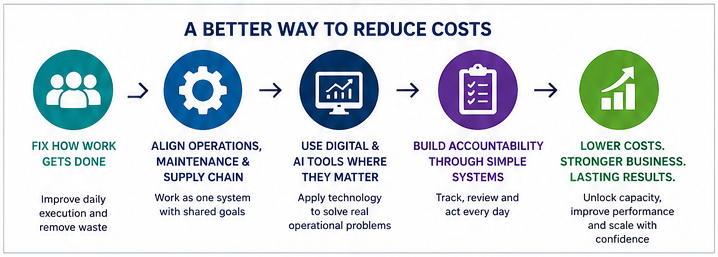
Sustainable cost reduction comes from improving how the business runs, not cutting around the edges.
It means:
- Fixing how work gets done every day
- Aligning operations, maintenance and supply chain
- Using digital and AI tools where they matter
- Building accountability through simple systems
When done well, cost goes down but the business also becomes stronger and easier to scale.
Final Thought
If cost reduction feels like a cycle launch initiative, see limited results, repeat, it may be worth asking a different question.
Are we trying to cut costs or are we fixing how the business operates?
The companies that focus on execution do more than reduce cost. They improve performance, unlock capacity and create results that last.