
Most plants have run lean manufacturing for years: standard work, 5S, kaizen events, and boards on the shop floor. Then sensors, dashboards, and connected machines arrived, and a fair question came with them. Does Industry 4.0 replace that older work, or build on it?
Lean principles stay in place. What changes is the information behind them. A problem that once appeared at the end of a shift now appears in seconds. That speed only helps when someone is responsible for acting on the signal, and many plants never set up that part. The sections below explain which lean methods still matter, how the classic tools look in digital form, where AI helps and where it does not, how the World Economic Forum’s Lighthouse Operating System maps the same ground, and in what order the work should happen.
TL;DR
- Lean manufacturing is not being replaced. The principles stay the same. Problems now show up in seconds, and the information reaches more people.
- Stabilize the process first. Digital tools applied to an unstable process record the problem rather than remove it.
- Almost every classic lean tool has a digital form, from standard work to andon, SMED, TPM, and root cause analysis.
- Every line should define the same measures the same way before anything goes on a screen. ISO 22400 gives standard definitions.
- AI helps where a decision repeats and the data is reliable. It does not create accountability or fix an unstable process.
- Sequence: stabilize, agree definitions, map the value stream, connect what matters, build the management routine, then add analytics.
- The Lighthouse Operating System, the World Economic Forum’s open framework, builds on lean rather than replacing it and grades each capability on five maturity levels.
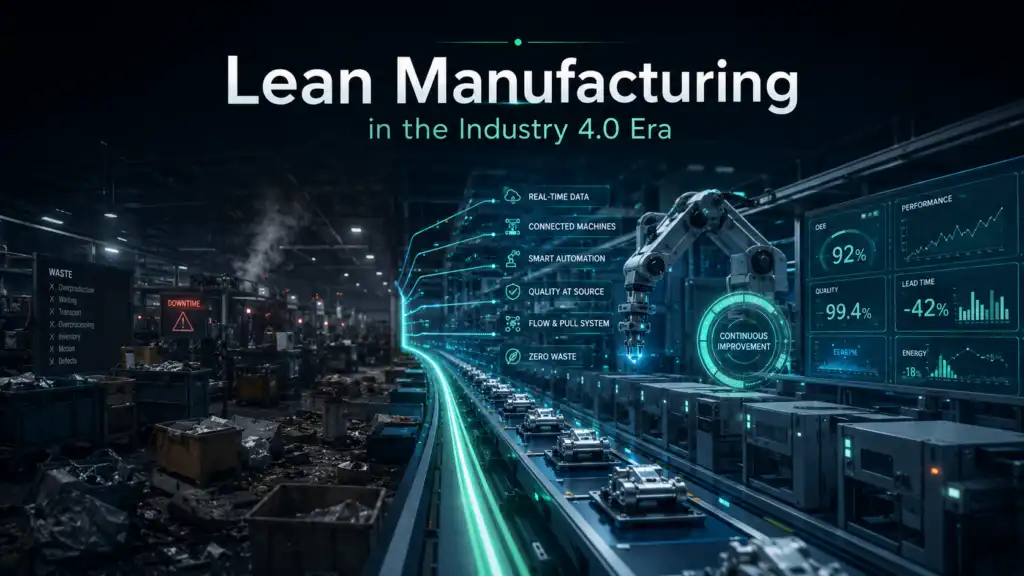
Lean manufacturing is not being replaced by Industry 4.0. The principles hold: remove waste, stabilize the process, make problems visible, and fix causes rather than symptoms. The information behind those decisions has changed. It arrives faster and it carries fewer gaps.
In a connected plant, the system flags a downtime event in seconds instead of at the end of the shift. It logs a changeover loss instead of leaving it to someone’s recollection. The supervisor spots the problem and decides sooner, which is what lean manufacturing always aimed for.
Manufacturers are paying for that speed. ABI Research forecasts $224.7 billion of digital transformation spending in industrial manufacturing in 2026, up 13.8 percent year over year. That spending pays back only when the plant underneath it can act on what it reports.
What does lean manufacturing look like in a connected factory?
Lean manufacturing in a connected factory is the same set of lean principles applied to live operational data instead of manual reporting. The goal has not moved. The feedback loop is shorter, and it now runs across departments instead of inside one area.
What lean manufacturing is
Lean manufacturing is a customer-focused way of running operations that removes activity the customer does not pay for. Its core methods come from the industrial engineering tradition of studying work and designing waste out of it: value stream mapping, kaizen, 5S, standard work, and structured root cause analysis. Spear and Bowen set out the underlying logic in Decoding the DNA of the Toyota Production System, the study the World Economic Forum still cites when it describes how Toyota keeps its flows tightly scripted and its operations flexible at the same time.
What Industry 4.0 and industrial IoT are
Industry 4.0 connects machines, sensors, systems, and people so operators can act on plant data while the work is happening. Industrial IoT is the sensing and connectivity layer underneath it. NIST frames smart manufacturing as fully integrated, collaborative systems. They respond in real time to changing conditions inside the plant, across the supply network, and in what customers need.
What people mean by Lean 4.0
Lean 4.0 is the label for the combination of lean manufacturing methods and Industry 4.0 technology. Academic reviews of the field treat the two as complementary rather than competing, and study how digital tools change the way lean methods are applied on the floor.
What is the Lighthouse Operating System?
The Lighthouse Operating System is an open framework for running industrial operations, developed by the World Economic Forum with NEOM and 11 industry partners and published in April 2025. It treats lean as the foundation. The white paper names Lean, Six Sigma, and the Theory of Constraints as the methods manufacturers have relied on for decades, and says their core principles remain relevant. The gap it identifies is that those methods were not designed to capture the digital opportunity. The framework and its pilots are published openly.
The framework sets out six operating principles: adaptable and robust processes, connected and transparent flows, end-to-end synchronization, embedded sustainability, a learning organization, and accelerated digital and data. Each capability is graded on five maturity levels, from Standardized through Process-optimized, Technology-enabled, and Business-shaping to Ecosystem-leading. Level 1 is labeled traditional or pre-lean, which puts basic lean discipline at the bottom of the ladder rather than outside it.
Does Industry 4.0 replace lean manufacturing or work alongside it?
It works alongside it. The two answer different questions, and together they cover ground neither covers alone.
Lean manufacturing | Industry 4.0 | |
|---|---|---|
Core question | Which activity does not add value? | What is happening right now, and why? |
Main lever | Process design, standards, and behavior | Connected data, automation, and analytics |
Feedback speed | Shift, day, or week | Seconds to minutes |
Failure mode on its own | Gains fade once the improvement event ends | Data grows, but daily behavior does not change |
Lean manufacturing helps you identify what needs to change, while Industry 4.0 shows you what is happening in real time. Yet each can fall short on its own. Lean initiatives can lose momentum after kickoff, while digital projects can produce dashboards that no one uses to make decisions.
What lean fundamentals still matter as manufacturers adopt AI and connected systems?
All of them. Every plant still needs:
- stable processes that behave the same way across shifts
- standard procedures people follow
- equipment that runs reliably
- planning that reflects real capacity
- clear ownership of results at each level
- an improvement routine that outlasts the kickoff
Where any of these are missing, the technology shows the problem faster without solving it. Inconsistent operating practices produce inconsistent data, and weak data undermines every analysis built on top of it. Technology amplifies the discipline of running the plant the same way every shift. It cannot supply that discipline.
The Lighthouse Operating System places these same basics at its first two maturity levels, Standardized and Process-optimized, before any technology enters the picture.
What role does real-time visibility play in modern lean manufacturing?
Real-time visibility helps teams respond sooner by showing problems as they develop. Manual reports, boards, and spreadsheets still support lean manufacturing, but often reveal losses only after they happen. Connected systems shorten that delay by providing:
- live production performance against plan
- equipment status in one view
- performance reporting without manual data entry
- status boards at the line that update themselves
- downtime logged with reason codes as it happens
- an automatic alert when a measure crosses its limit
The same stream feeds the maintenance and reliability practices that used to depend on knowledge held by a few experienced people.
Collecting the data is the easy half. In Rockwell Automation’s 2026 study of more than 1,500 manufacturers, only 43 percent of collected data is used effectively, which makes execution the limiting factor rather than the supply of data. A screen without an owner changes nothing.
Which measures belong on a digital board
Choose a small set and define each one the same way everywhere. ISO 22400 sets out a common group of performance measures for manufacturing operations, including the formulas behind them, so plants, suppliers, and software all describe performance in the same terms. A workable starting set:
- OEE, split into availability, performance, and quality
- schedule adherence
- first pass yield and scrap rate
- unplanned downtime by reason code
- mean time between failures and mean time to repair
- changeover time
Consistent definitions matter more than the exact list. Once two lines calculate OEE differently, nobody can compare them.
Classic lean manufacturing tools and their digital equivalents
Most lean manufacturing tools do not disappear in a connected plant. They change format, and the evidence behind them gets stronger.
Lean tool | Digital form | What changes |
|---|---|---|
Standard work | Digital work instructions on a tablet | Updates reach every shift at once, and the version used is visible |
Value stream mapping | Maps built from MES, ERP, and sensor data | Cycle times come from records, not stopwatch samples |
Visual management | Live dashboards at the line | The number is current, so the team argues about the cause, not the number |
Andon | Automatic alerts and rule-based escalation | The response starts before anyone walks past the line |
Kanban | Signals tied to actual consumption | Signal timing adjusts as demand moves |
SMED | Changeover timing captured step by step | Each step is timed, not only the total |
TPM | Condition monitoring and predictive alerts | Asset condition triggers the work instead of the calendar |
Root cause analysis | Event data, time stamps, process history | The timeline is factual, which shortens the debate |
In each row the method holds and the evidence behind it gets better. The eight wastes work the same way. Live data will not remove overproduction, waiting, transport, over-processing, inventory, motion, defects, or unused skill, but it makes each one measurable, which is the hard part.
The Lighthouse Operating System grades the same progression. For synchronized material flow it starts with a basic pull or first-in-first-out system run on kanban cards, moves through electronic and then digital kanban with RFID tagging, and ends with an autonomous flow planning agent. The signal does not disappear at the top of the ladder. It becomes automatic.
Where AI helps in lean manufacturing, and where it does not
AI earns its place when it sits inside a decision someone already has to make. Isolated pilots seldom survive contact with the plant. Manufacturers put AI to work on predictive maintenance, production scheduling, quality analytics and defect detection, anomaly detection on process parameters, and root cause analysis across large data sets.
Condition-based approaches move maintenance off a fixed calendar and onto the state of the asset, which was the point of TPM all along. Our breakdown of AI predictive maintenance ROI covers where that value shows up and where plants lose it. Used this way, AI makes lean principles easier to apply at scale. Where it does not help:
- AI needs consistent, labeled data. If downtime reasons are entered inconsistently, the model learns the inconsistency.
- AI does not create accountability. A prediction with no owner and no response routine produces nothing.
- AI does not fix an unstable process. It describes the instability in more detail, and model output still needs a review path.
How do operational discipline and lean principles combine with digital tools?
Through a management operating system. Traditional lean work sat inside one department. In a connected plant, production, maintenance, quality, engineering, and supply chain share the same data, so they need shared routines too. A digital management operating system sets:
- which measures matter at each level, from line to plant to business
- how often the meetings happen and what is on the agenda
- the rule for raising an issue: what triggers it, to whom, and within what time
- who owns each action, and by when
- who reviews those decisions afterward
The aim is a shorter path from signal to decision, and the same response to the same signal on every shift.
Why does digital transformation in industrial manufacturing fail to deliver results?
Adoption fails more often than the technology does. The system runs as specified, and the daily routine around it stays exactly as it was. Rockwell’s study puts numbers on the split: 59 percent of manufacturers now use smart manufacturing technologies in daily operations, while 18 percent are still running pilots.
A common pattern is to install dashboards, connected systems, and automated reporting without changing how the plant operates. Processes remain inconsistent, teams lack routines for using the data, and responsibility becomes unclear when problems cross departments. Without those changes and the training to support them, the technology never becomes part of daily decision-making.
Closing that gap is the practical work of Industry 4.0 and AI implementation. What to do differently:
- Define the decision first, then the data that supports it.
- Give every measure an owner before it goes on a screen.
- Change the meeting before changing the tool.
- Count adoption rather than deployment: how many decisions changed.
How to combine lean manufacturing with connected systems: a practical sequence
- Stabilize first. Reduce process variation, confirm standard work, and restore equipment reliability in the target area. Digital tools on an unstable process produce noise.
- Agree on definitions. Decide how OEE, downtime reasons, scrap, and schedule adherence are calculated, then apply that everywhere. Use ISO 22400 rather than inventing a local standard.
- Map the value stream as it is. Use system data where it exists and direct observation where it does not. The gaps show where visibility is missing.
- Connect the few things that matter. Start with the bottleneck and the assets driving most of the downtime. Leave full connectivity for later.
- Build the management operating system around the data. Set the meeting schedule, the agenda, the rule for raising issues, and the owners before adding screens.
- Add analytics and AI where a decision repeats. Maintenance triggers, sequencing, and quality checks are the usual starting points.
- Measure whether behavior changed. Track response time, action closure rate, and whether the improvement held three months later.
Who helps manufacturers apply lean principles inside an Industry 4.0 environment?
Someone has to run industrial engineering, lean manufacturing, and the connected systems as one job rather than three. Implementation Engineers embeds implementation leaders with the client team and executes the change on the floor through the enCompass® model: Align, Design, Execute. They stay until the new way of working is part of daily operations. Align and Design take weeks, not months.
Each engagement reports results in plant measures: throughput, uptime, quality, and cost. In one multi-plant steel operation, AI-enabled weld inspection delivered more than $6.5 million in annual benefit, with quality standardized across plants. In another, forecast accuracy improved from 50 percent to 85 percent across more than 240 products. Results depend on the starting condition of the plant, so the sequence above matters more than the choice of tool.
Where the bottleneck is throughput, reliability, or a digital system that is installed but unused, manufacturing implementation and operations and production optimization are where that work starts.
Connected systems have raised the return on doing lean manufacturing properly, because a disciplined plant turns better data into results faster than a disorganized one. The discipline comes first and the tools come second.
Frequently asked questions
What is Lean 4.0?
Lean 4.0 is the term for combining lean manufacturing methods with Industry 4.0 technology. In practice it means running standard work, visual management, pull signals, and root cause analysis on live plant data instead of manual reporting. Same methods, better evidence.
Must lean come before Industry 4.0?
In most cases, yes. Digital tools applied to an unstable process record the instability rather than remove it. Process stability, standard work, and equipment reliability make the data trustworthy enough to act on.
How are European manufacturers applying lean manufacturing with Industry 4.0 technology?
The same way, under tighter energy and regulatory constraints. The World Economic Forum’s Global Lighthouse Network recognizes 238 sites across more than 30 countries, including European plants. Beko, part of Koç Holding, piloted the Lighthouse Operating System on its cooking-appliance line in Bolu, Türkiye. The three-month assessment focused on adaptable and robust processes and on connected and transparent flows, and set a target of more than 20 percent capacity and efficiency gain on the high-runner line without adding headcount.
How does AI support lean manufacturing?
AI supports lean manufacturing where a decision repeats and the data is reliable: predicting equipment failure, sequencing production, spotting quality drift, and flagging process anomalies. It speeds up the analysis step. The improvement routine still has to close the loop.
Which KPIs should a connected plant track?
Plants should start small and define each one the same way everywhere: OEE with its availability, performance, and quality components, schedule adherence, first pass yield, unplanned downtime by reason code, and mean time between failures and to repair. ISO 22400 gives the standard definitions.