
AI in Life Sciences has become one of the biggest priorities across the AI in life sciences industry. Pharmaceutical, biotechnology, and medical device manufacturers are investing heavily in AI to improve manufacturing performance, accelerate research, strengthen quality systems, optimize supply chains, and reduce costs.
Most organizations are no longer asking whether AI has potential. They have identified use cases established governance committees launched pilots and begun experimenting with copilots and advanced analytics.
Yet many initiatives struggle to move beyond proof of concept.
The reason is not the technology.
In our experience AI projects rarely fail because the models are not sophisticated enough. They fail because the operational environment is not ready to support them.
Successful AI implementation requires more than selecting the right platform. It requires structured data standardized processes digital workflows clear governance and an operating model capable of embedding AI into the way work is performed every day.
AI Doesn’t Solve Operational Problems—It Exposes Them
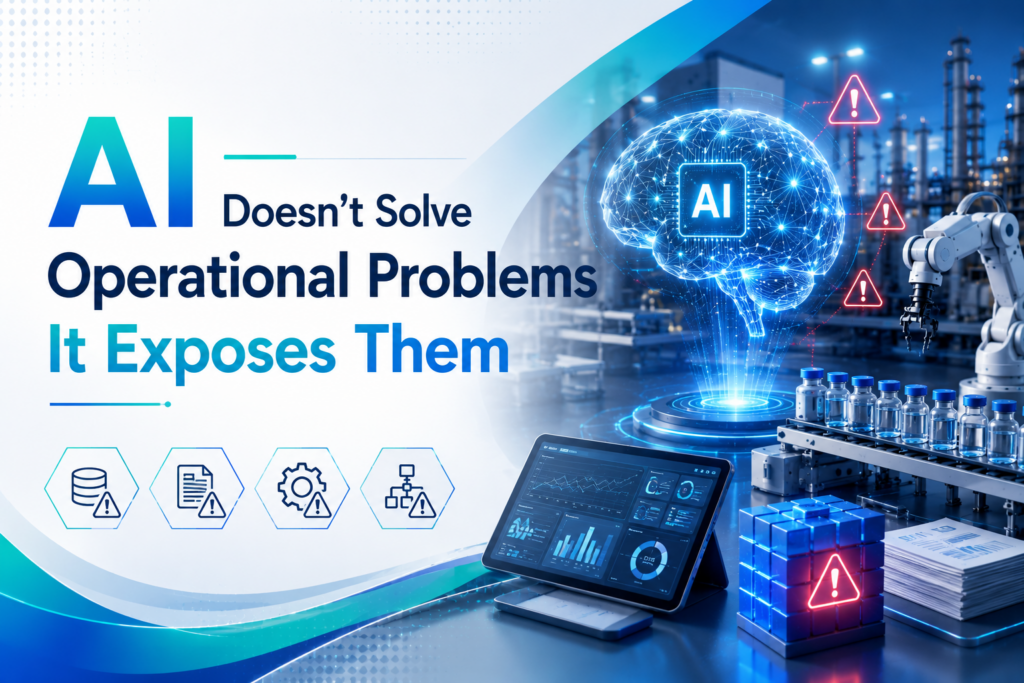
One of the biggest misconceptions surrounding AI is that it can overcome operational complexity. In reality AI amplifies whatever environment it is deployed into.
Organizations with standardized processes reliable data and disciplined execution often realize significant improvements in productivity and decision-making.
Organizations with fragmented processes disconnected systems inconsistent data and unclear ownership frequently discover that AI simply exposes problems that have existed for years.
Across recent life sciences engagements we have found that the greatest barriers to AI adoption were not model accuracy or computing power. They were operational issues including inconsistent data structures disconnected systems duplicate information governance bottlenecks manual workflows and processes that made even simple changes difficult to implement.
That work may not receive the same attention as generative AI in life sciences, but it is often what determines whether AI initiatives scale successfully.
AI Requires a Data Foundation—Not Simply More Data
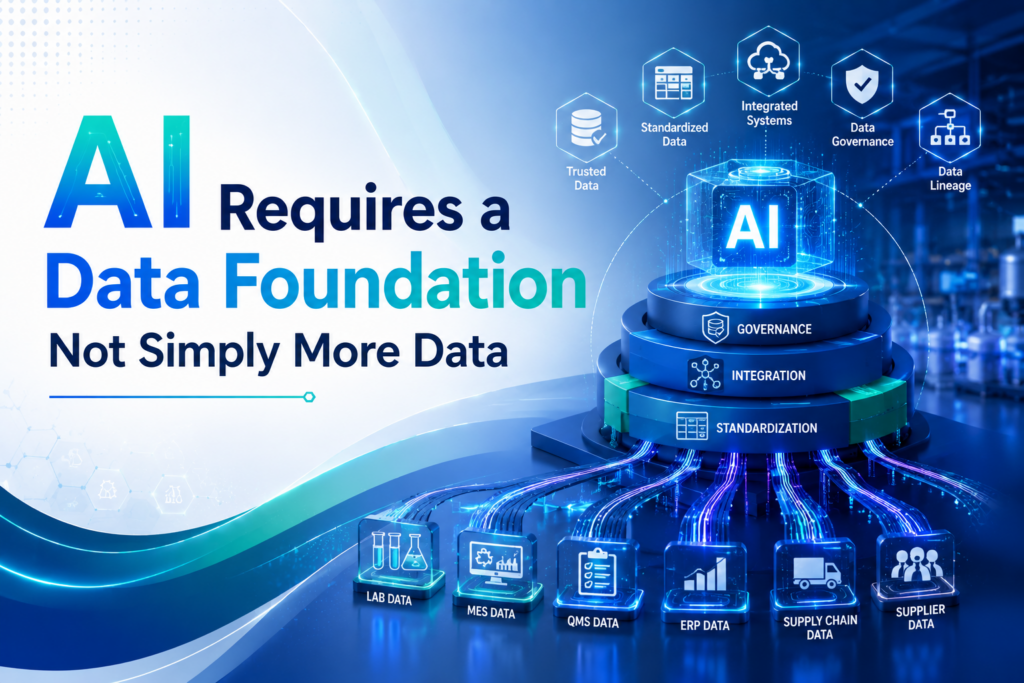
Life sciences organizations generate enormous amounts of valuable information. Research data lives within electronic laboratory notebooks. Manufacturing data resides in MES platforms and historians. Quality information exists across QMS applications spreadsheets and documentation systems. Supply chain data is distributed across ERP systems planning tools and supplier platforms.
The challenge is not a lack of information. The challenge is that much of it exists in different formats uses inconsistent terminology lacks common ownership and cannot easily be searched or connected.
One recent life sciences assessment found that scientists were capturing similar information using numerous templates with different structures relying heavily on free-text documentation instead of structured data and working across disconnected systems that limited reuse of valuable knowledge. The result was not a shortage of data but a shortage of usable data.
Creating a data foundation for AI means establishing common schemas data lineage governance and integration across systems so information can be trusted and reused.
That work may not receive the same attention as generative AI but it is often what determines whether AI initiatives scale successfully.
The Real Opportunity Is Making Knowledge Accessible
One of the most valuable applications of life science AI is not generating new information but helping employees find and use the information the organization already possesses.
Scientists engineers quality professionals and manufacturing teams often spend significant time searching through laboratory notebooks documentation reports and historical records to answer questions that have already been solved somewhere else within the organization.
Modern AI search capabilities allow users to ask questions in natural language and receive cited source-linked answers in seconds rather than manually navigating multiple systems or relying on colleagues for institutional knowledge.
The productivity improvement comes from reducing the time required to locate trusted information enabling employees to spend more time solving problems and less time searching for answers.
Digital Processes Must Come Before Intelligent Processes
Organizations often attempt to introduce AI into environments that still rely heavily on manual processes. Paper documentation. Spreadsheet-based workflows. Disconnected quality systems. Manual data entry. Redundant approvals.
AI cannot fix poorly designed processes. It simply automates parts of them.
The organizations achieving the greatest value typically begin by digitizing and standardizing operational workflows. Electronic Device History Records connected manufacturing systems digital quality processes and integrated operational data create the foundation that allows AI to generate meaningful insights and support better decisions.
Digital transformation in life sciences and AI implementation are not separate initiatives. They are closely connected stages of the same operational journey.
The Sequence Matters More Than the Technology
Many AI programs begin by selecting software. The most successful programs begin by designing the operating environment that AI will support.
That includes:
- Establishing a structured data foundation
- Standardizing operational processes
- Defining governance and ownership including ai governance in life sciences
- Connecting critical systems
- Preparing IT and validation requirements
- Prioritizing implementation through a phased roadmap
Many organizations accelerate this work by partnering with AI consulting for life sciences providers and life sciences consulting firms that understand regulatory requirements and operational complexity.
When these elements are addressed first AI initiatives can move from pilot projects to enterprise deployment far more effectively. When they are ignored organizations often spend months developing AI capabilities that cannot be successfully adopted because the surrounding operational environment is not ready.
Technology implementation is rarely the longest part of an AI journey. Preparing the organization for sustainable adoption usually is.
AI Is an Operating Model Transformation
One of the most overlooked aspects of AI implementation is organizational design. Successful AI programs require more than software deployment.
They require:
- Clear ownership
- Cross-functional governance
- Standardized change processes
- Defined decision-making responsibilities
- Sustainable management systems
- Adoption by the people using the technology every day
Without these elements AI remains a pilot rather than becoming part of normal operations.
The organizations seeing the greatest return are embedding life science AI directly into manufacturing execution, quality management, maintenance, laboratory operations, and supply chain planning, not as separate technology projects but as integral parts of how work gets done.
Moving from AI Strategy to AI Execution
The conversation surrounding AI in Life Sciences has changed. The question is no longer whether AI can create value. It can.
The question is whether organizations have built the operational foundation necessary to realize that value at scale.
Artificial intelligence is most effective when supported by structured data standardized processes integrated digital systems strong governance and disciplined operational execution.
Organizations that invest in those foundations will not simply deploy more generative AI in life sciences. They will achieve better business outcomes from improved productivity and quality to faster decision-making, stronger compliance, and more resilient operations.
In the years ahead competitive advantage will not belong to the organizations experimenting with the most AI In the years ahead, competitive advantage will not belong to the organizations experimenting with the most AI tools. It will belong to the organizations that successfully integrate AI into the way their business operates every day with support from experienced AI consulting for life sciences specialists.
FAQs
Why do many AI initiatives in life sciences stall after pilots?
The primary barrier is not the technology but operational readiness. AI amplifies the environment it enters. When processes are fragmented data is inconsistent and workflows are manual AI exposes long-standing issues instead of delivering value.
What is a data foundation for AI and why is more data not enough?
A data foundation means common schemas clear lineage governance and integration so information is trusted and reusable. The problem is not lack of data but inconsistent formats terminology and ownership that make data hard to use.
Where is the most immediate value of AI in life sciences today?
Making knowledge accessible. AI search lets users ask natural language questions and get cited answers in seconds reducing time spent searching through documents and notebooks.
Why must digital processes come before intelligent processes?
AI cannot fix manual or poorly designed workflows. Organizations that succeed first digitize and standardize operations like eDHR connected systems and digital quality processes before layering AI.
What sequence should organizations follow for AI execution?
Start by building the operating environment AI will support including structured data standardized processes governance system integration and a phased roadmap. AI adoption is an operating model transformation that requires ownership cross-functional governance and everyday user adoption for lasting results.