
Many manufacturers invest heavily in operational improvements, yet asset performance issues continue to affect throughput, quality, cost, and delivery. Equipment failures create instability, maintenance teams stay reactive, backlogs grow, and reliability problems become the norm.
This is when organizations typically turn to asset management consultants. But many executives still ask: What do they actually implement?
The answer depends on the firm. The strongest ones go beyond assessments and software. They embed themselves in operations to build sustainable systems, processes, behaviors, and accountability. This hands on approach is what differentiates effective asset management consulting from traditional advisory engagements.
Asset Management Is More Than Just Maintenance
Effective asset management is not limited to fixing equipment. It is a strategic approach to ensure physical assets deliver maximum business value through:
- Higher reliability and uptime
- Stable throughput
- Better cost control
- Improved asset utilization
- Reduced operational risk
- Stronger capital effectiveness
The ultimate goal is a stable, predictable, and financially efficient operation. Strong industrial asset management practices help organizations align maintenance with broader business objectives.
Core Areas Asset Management Consultants Implement
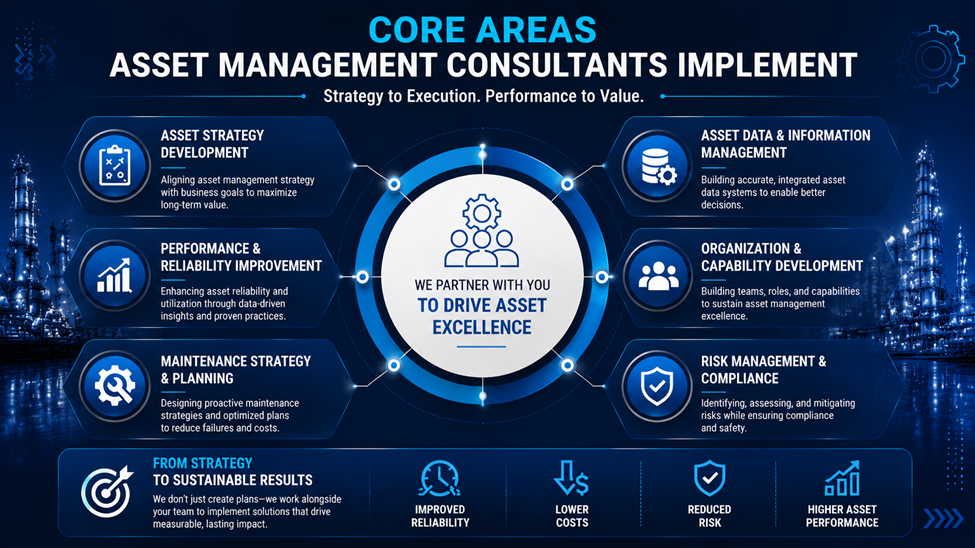
Leading asset management consultants focus on building proactive reliability systems across the entire operation. Here are the key areas they typically implement:
1. Leadership Alignment & Asset Strategy
Many organizations treat reliability as a maintenance issue instead of a business driver. Asset management consultants establish:
- Asset management governance structures
- Reliability leadership routines
- Asset criticality strategies
- Clear reliability KPIs and targets
- Cross-functional operating models
This shifts reliability from a support function to a core operational strategy. Many organizations also rely on asset management consulting services to align leadership around long term reliability goals.
2. Asset Criticality & Risk Management
Not all assets carry equal risk. Consultants implement:
- Asset criticality assessments
- Risk-based maintenance strategies
- Reliability-Centered Maintenance (RCM)
- Failure mode and consequence analysis
This ensures maintenance resources focus on the equipment that matters most while strengthening asset reliability management across critical operations.
3. Predictive Maintenance & Reliability Programs
A major focus is moving from reactive to proactive maintenance. Key implementations include:
- Preventive maintenance optimization
- Predictive maintenance programs (vibration, thermography, oil analysis)
- Condition monitoring systems
- Precision maintenance standards
- Defect elimination processes
These initiatives are often led by experienced asset reliability consultants who help organizations improve long term equipment performance.
4. AI for Predictive Maintenance
Modern asset management consultants help integrate AI-powered solutions, including:
- AI anomaly detection
- Failure prediction models
- Asset health dashboards
- Predictive scheduling
The real value lies in operational adoption by ensuring teams actually act on the insights. AI also supports asset reliability management by identifying risks before failures occur.
5. Work Management Excellence
Poor planning keeps teams stuck in firefighting mode. Consultants implement structured systems for:
- Maintenance planning and scheduling
- Backlog management
- Work prioritization
- Operations-maintenance coordination
High-performing plants typically achieve 80%+ planned maintenance. Effective industrial asset management depends on disciplined work management and execution.
6. Data Quality & Digital Asset Management
Reliable data is the foundation of good decisions. Implementations often include:
- CMMS / SAP PM optimization
- Asset hierarchy redesign
- Failure code standardization
- Reliability analytics and dashboards
Many asset management consulting services also focus on improving data quality to support better maintenance planning and decision making.
7. Reliability Engineering & Root Cause Elimination
Sustainable improvement comes from eliminating recurring failures through:
- Root Cause Analysis (RCA) systems
- Bad actor programs
- Reliability engineering workflows
- Continuous improvement routines
This structured approach allows asset reliability consultants to eliminate repeat failures instead of repeatedly fixing the same problems.
8. Management Operating System (MOS) for Reliability
To ensure changes last, consultants build daily management systems that create:
- Performance visibility
- Escalation mechanisms
- KPI reviews
- Cross-functional accountability
- Standard leadership routines
These systems support long term asset reliability management by creating accountability across operations and maintenance teams.
9. Operations Ownership & Operator Care
Asset reliability improves dramatically when operations takes ownership through:
- Autonomous maintenance
- Operator inspections and care routines
- Early defect detection
These practices are fundamental to successful industrial asset management because operators become active participants in reliability improvement.
10. Skills Development & Reliability Culture
Technology alone is not enough. Consultants also drive:
- Reliability training programs
- Planner/scheduler development
- Precision maintenance behaviors
- Workforce accountability systems
Experienced asset reliability consultants help build the skills and culture needed to sustain reliability improvements long after implementation is complete.
Asset Management Consultants vs Traditional Consulting
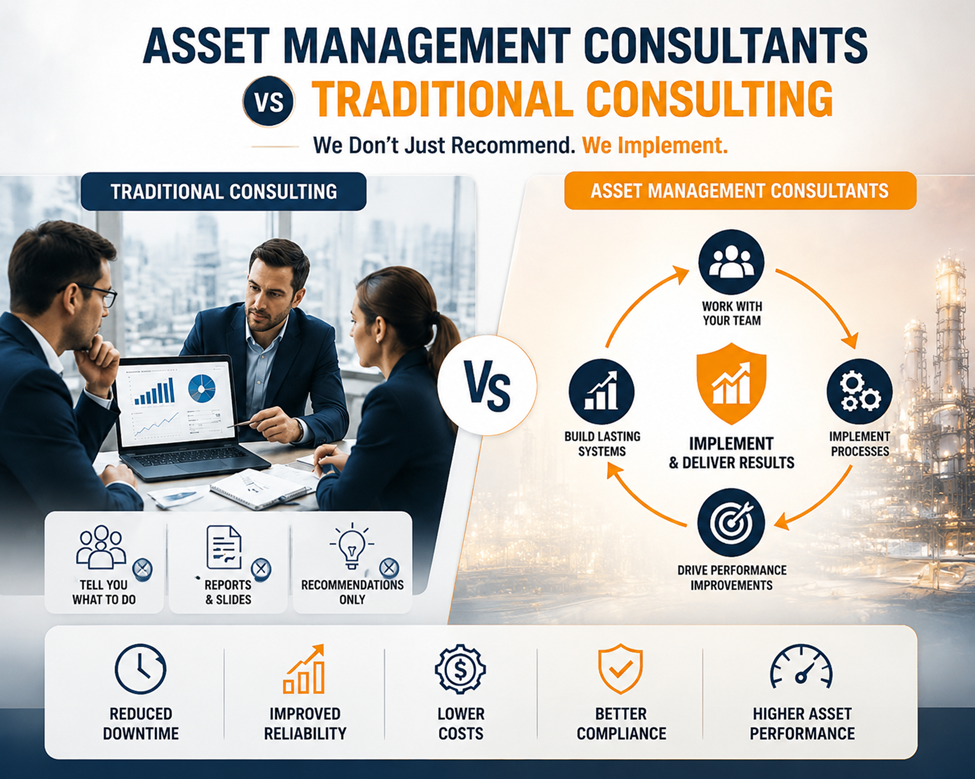
Unlike traditional firms that mainly deliver reports and recommendations, implementation-focused asset management consultants work hands-on by:
- Embedding with operational teams
- Implementing processes on the shop floor
- Building execution discipline
- Creating sustainable accountability systems
- Delivering measurable performance improvements
Organizations investing in asset management consulting services often see greater long term value because implementation remains the primary focus rather than recommendations alone.
Final Thoughts
The best asset management consultants do much more than evaluate performance. They implement the complete system — processes, tools, behaviors, and leadership practices — required for long-term asset reliability and operational excellence.
By combining proven asset management consulting practices with strong asset reliability management, manufacturers can improve equipment performance, reduce operational risk, and build a more stable, predictable, and profitable operation.