
TL;DR
- AI in manufacturing has moved out of pilot programs and into live production environments. Investment is not the constraint. Execution is.
- The trends delivering results today: computer vision inspection, predictive maintenance wired into maintenance workflows, continuous planning and forecasting, and digital twins used to test changes before making them.
- Agentic AI is the newest arrival and the one furthest ahead of reality. Most operational uses still need a human in the loop.
- AI is not removing people from plants. It is changing what a technician or supervisor is expected to know.
- Most AI projects stall for operational reasons, not technical ones. Manufacturers use only a small share of the data they generate, and many cannot act on it once collected.
- The companies seeing results got a few things right: a governed data foundation, use cases tied to a specific KPI, a named owner for the decision, and integration into daily management routines.
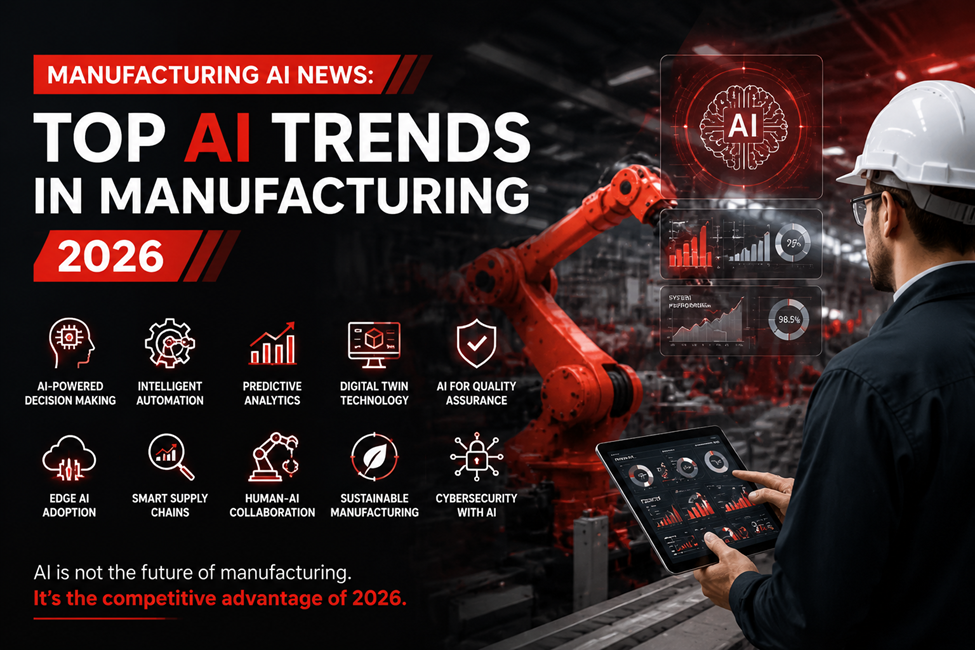
Artificial intelligence is everywhere in manufacturing right now. This is a snapshot of what is real, not what is promised.
Every company has a roadmap. Every executive is talking about AI, and every vendor is promising transformation. But when you look inside operations, far less has changed than the headlines suggest.
The gap comes down to implementation. Not what gets planned at a strategic level, but what actually runs on the floor.
Here are the trends in AI in manufacturing that are working right now, based on what is delivering results in production environments.
What is AI in manufacturing?
AI in manufacturing is the use of machine learning, computer vision, predictive analytics, and generative AI to improve how products are designed, produced, inspected, maintained, and delivered.
In practice, that means systems that analyse sensor and process data, detect defects, forecast demand, schedule production, predict equipment failures, and support the people running the plant.
The technology is not new. What has changed is where it sits. Artificial intelligence in manufacturing has moved out of the innovation lab and into daily operations.
How far has adoption actually gone?
Further than most people assume, and less far than most vendors claim.
The market is growing quickly. The global market for artificial intelligence in manufacturing was valued at USD 5.32 billion in 2024 and is projected to reach USD 47.88 billion by 2030, according to Grand View Research. North America held the largest regional share, and production planning was the largest application segment.
Investment in AI manufacturing is not the constraint. Execution is.
Most manufacturers have either invested in AI or plan to. Far fewer have it embedded in how the plant runs every day. That distance between spending and operating is the real story of AI in manufacturing in 2026.
1. AI is moving from pilots to full operational deployment
The biggest shift right now is AI moving into full production environments.
For years, AI in manufacturing lived in pilot programs. Small proofs of concept. Isolated use cases run by innovation teams without touching the core operation.
That is changing. We are now seeing:
- Production planning systems running entire plants, not just assisting planners
- Scheduling, material flow, and capacity decisions automated in real time
- AI replacing manual planning processes rather than supporting them
The same pattern is showing up outside discrete manufacturing. In asset-heavy sectors, the operators pulling ahead are the ones treating AI as an operating change rather than a technology project, which is exactly the pattern behind the AI use cases in utilities that are actually driving value.
This is the difference between experimenting with AI and operating with AI.
2. AI is becoming part of production, not a side tool
Another major trend: AI is no longer sitting outside the process.
It is being embedded directly into how production runs. That means controlling process variables in real time, sitting inside quality inspection lines, and driving dispatch, scheduling, and asset utilisation decisions.
In high-volume environments, AI in manufacturing now makes decisions in milliseconds, operates continuously, and runs with limited human intervention.
Much of this depends on where the computing happens. Analysis from RTInsights points to the deepening integration of AI with real-time analytics at the edge, and a shift toward more autonomous operations as a result.
This is not reporting. This is control.
3. How is computer vision replacing manual quality inspection?
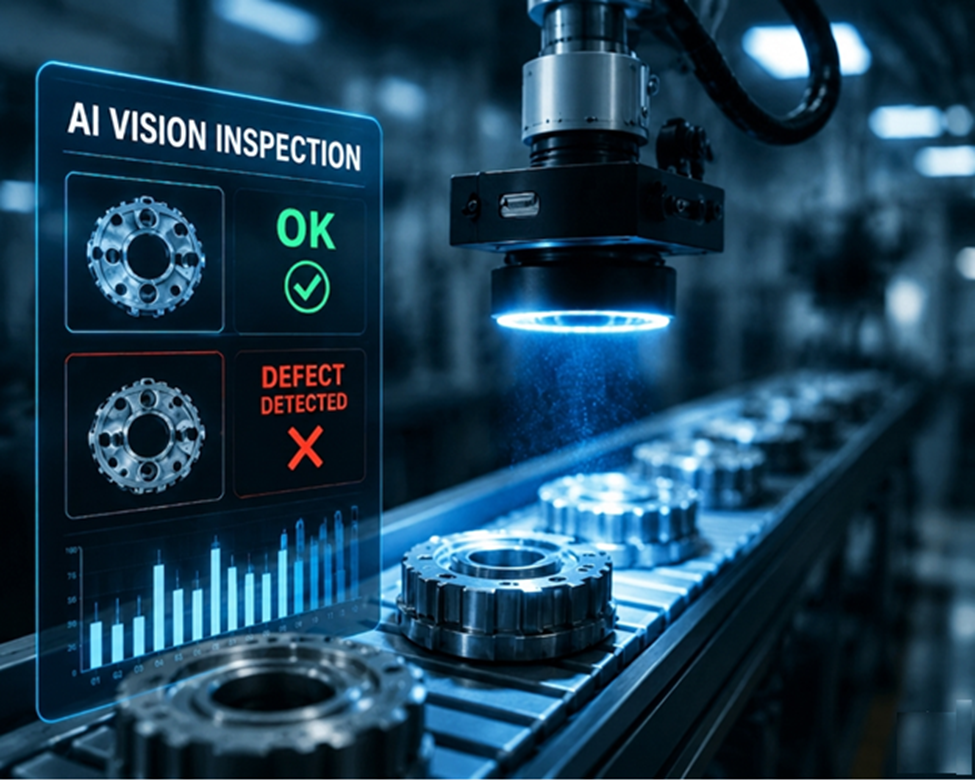
Computer vision is replacing manual inspection because it detects defects at full production speed and delivers consistent results across every shift.
Manual inspection does not scale. Inspectors get tired, standards drift between shifts, and throughput is capped by how fast a person can look.
In practice, this looks like:
- Weld inspection systems identifying defects automatically
- Food processing lines flagging quality issues in line
- Medical device manufacturers inspecting for microscopic defects
Quality is also where regulated industries feel the most pressure, because inspection evidence has to hold up to audit as well as to production targets. That is why the sequencing matters so much in the operational foundation for AI in life sciences.
The value is immediate: better yield, lower inspection labour, fewer defects reaching the customer.
4. What is different about predictive maintenance now?
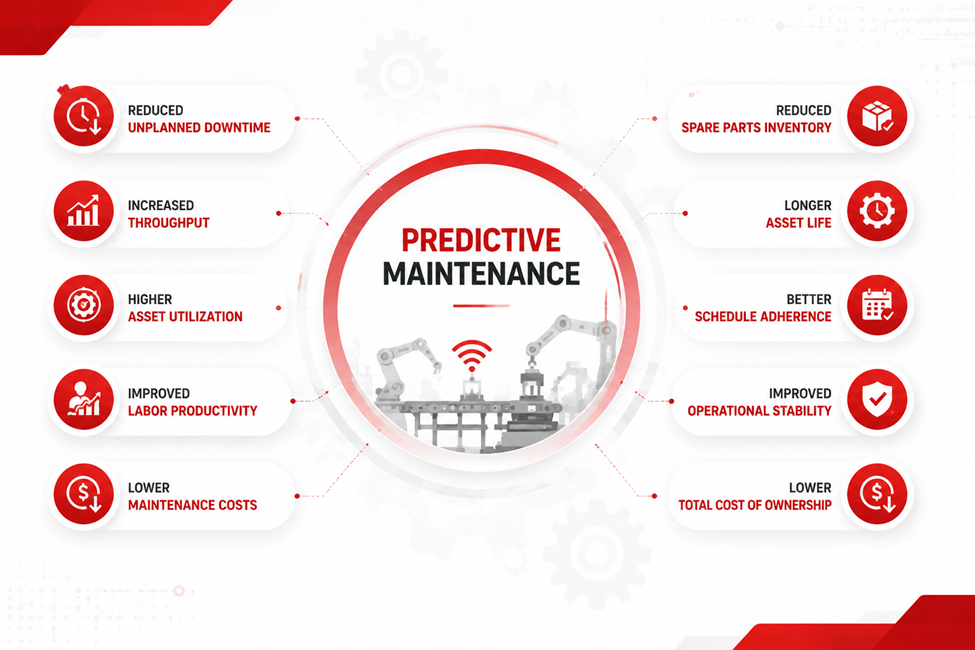
Predictive maintenance has moved past dashboards and alerts. AI now monitors equipment continuously, predicts failures, and pushes recommended actions into the maintenance workflow.
That last part is the change. For years, predictive maintenance produced insight that nobody acted on. Alerts landed in a system that maintenance planners did not use, so nothing happened.
The current generation works differently:
- Continuous monitoring of equipment signals
- Real-time failure prediction
- Automated maintenance recommendations
- Integration into daily planning and scheduling routines
None of it works without reliable asset data and clear ownership, which is the same constraint we see in heavy industry and set out in the operational foundation AI in mining requires.
The key difference: AI is no longer just identifying issues. It is driving action.
5. AI is transforming planning and forecasting
Planning has historically been one of the most manual areas in manufacturing. Spreadsheets, tribal knowledge, and a monthly cycle that is out of date before it finishes.
That is changing quickly. Manufacturers are using AI to bring in external variables such as demand signals and economic data, update forecasts continuously, and align production with real demand rather than a fixed plan.
The gains are less about a better forecast number and more about a shorter decision cycle. Planning stops being a monthly event and becomes a continuous process.
Regulated and asset-heavy operators are under the same pressure to shorten that cycle, which is a large part of why AI implementation has become critical for U.S. utilities.
6. Digital twins are moving into operational use
A digital twin is a virtual model of a process, production line, factory, or supply chain that updates from live data.
According to IBM, digital twins let manufacturers simulate, analyse, and predict performance in real time, drawing on data from IoT sensors, programmable logic controllers, and machine learning models.
The practical use of AI in manufacturing here is testing changes before making them. Adjusting a line layout, a changeover sequence, or a maintenance window in the model first, then applying what works.
The barrier is not the technology. It is data quality. A digital twin built on incomplete or poorly structured plant data will produce confident answers that are wrong.
7. Agentic AI is arriving, carefully
Agentic AI is the newest trend in artificial intelligence in manufacturing, and the one where expectations are furthest ahead of reality.
The distinction matters. Generative AI drafts, summarises, and retrieves. Agentic AI coordinates multi-step work across systems, teams, and approvals: compiling incident reports, drafting corrective actions, generating shift handover notes, surfacing work instructions.
Manufacturers are already using agents to navigate supply disruption and sourcing risk, and around 22% plan to use physical AI such as robotic systems by 2027, Manufacturing Dive reports.
But most operational applications are high-stakes. Worker safety, regulatory compliance, and product release decisions all need a human in the loop. Analysts expect agentic AI to spread through manufacturing more slowly than in other sectors, and for good reason.
8. Will AI replace manufacturing jobs?
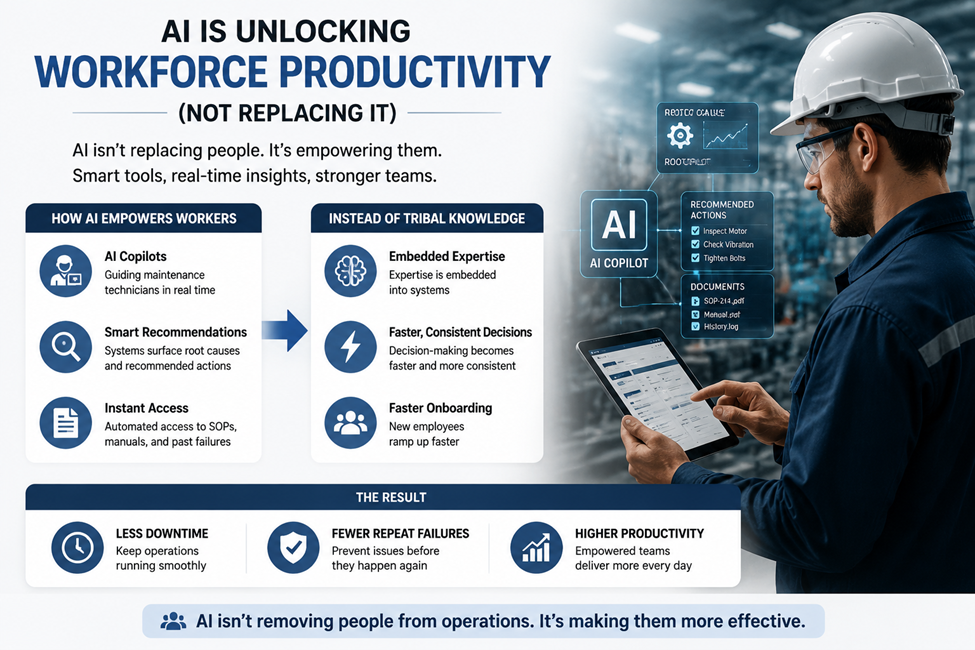
No. In manufacturing, AI is mostly changing what people spend their time on rather than removing the people.
The pattern we see is augmentation:
- Copilots guiding maintenance technicians through diagnosis
- Systems surfacing root causes and recommended actions
- Instant access to SOPs, manuals, and past failure history
This matters most where experience is walking out the door. Retirements are removing decades of undocumented process knowledge from plants, and capturing it before it goes is a genuine opportunity, not just a risk. It is the same argument set out in knowledge loss is one of mining’s biggest AI opportunities.
The skills question is real, though. What a plant engineer or line supervisor is expected to understand is shifting, a change explored in this Forbes Technology Council piece on AI and manufacturing skills.
AI is not removing people from operations. It is changing what good looks like in the role.
9. AI is moving from insights to decisions
This is the most important trend.
For years, AI in manufacturing focused on insights. Dashboards. Reports. Analytics. But insights do not change operations. Decisions do.
The progression looks like this:
- Visibility. A dashboard shows what happened.
- Alerting. The system flags an anomaly.
- Recommendation. The system proposes a specific action.
- Control. The system executes within defined limits.
Most manufacturers are stuck between the first two levels. The ones seeing real results have moved to the third and, in narrow and well-understood processes, the fourth.
This is the shift from visibility to control.
Why AI projects in manufacturing stall
Most failed projects using AI in manufacturing do not fail because the model was wrong. They fail because the data was not ready or because nobody owned the decision the model was supposed to support.
The data problem is the bigger one. ABI Research estimates manufacturers use only around 5% of the data they generate, and roughly 70% say they cannot prescribe an action after collecting and normalising it.
The other failure patterns are consistent:
- Use cases chosen without a clear value logic or a named owner
- Models deployed but never wired into daily management routines
- No process for acting on an output, so the output gets ignored
- Adoption treated as training rather than as a change in how work is run
None of these are technology problems. All of them are implementation problems.
What it takes to make AI in manufacturing work
The companies seeing results are not the ones with the most advanced strategies. They are the ones that got a small number of things right:
- A data foundation that is structured, governed, and accessible
- Use cases tied to a specific KPI and a specific decision
- Clear operational ownership before deployment, not after
- Integration into the management operating system, not alongside it
- Adoption driven through accountability, coaching, and leadership behaviour
Sector context changes the sequencing but not the principles, as the differences in what electronics manufacturers actually need in the AI era make clear.
AI does not create value when it is discussed. It creates value when it is implemented at scale.
The bottom line
AI manufacturing is no longer about experimentation. It is about execution.
AI is moving into production. It is being embedded into operations. It is starting to drive real decisions.
The question is not whether artificial intelligence in manufacturing will change the industry. It is who will implement it well enough to gain the advantage.
Frequently asked questions
What is AI in manufacturing?
AI in manufacturing is the use of machine learning, computer vision, predictive analytics, and generative AI to improve how products are designed, made, inspected, maintained, and delivered. It is applied to defect detection, demand forecasting, production scheduling, equipment monitoring, and operator support.
What are the main use cases for AI in manufacturing?
The most established use cases for artificial intelligence in manufacturing are predictive maintenance, computer vision quality inspection, production planning and scheduling, and demand forecasting. Digital twins and agentic AI workflows are growing quickly but are less mature in day-to-day operations.
Why do AI projects in manufacturing fail?
Most fail for operational reasons rather than technical ones. Common causes are poor or ungoverned data, use cases selected without a clear value case, no named owner for the decision the model supports, and deployment that never gets embedded into daily management routines.
What do you need in place before starting an AI project?
You need accessible and reasonably structured operational data, a use case tied to a measurable KPI, an owner accountable for acting on the output, and a plan for embedding the change into existing routines. Without the last two, the model produces output nobody uses.
What is a digital twin in manufacturing?
A digital twin is a virtual model of a process, line, plant, or supply chain that updates from live sensor and control system data. It is used to simulate and test changes before applying them in the physical operation.
Will AI replace manufacturing jobs?
Not in the way the headlines suggest. AI in manufacturing is mainly changing what people do rather than removing them. It guides technicians, surfaces root causes, and gives fast access to SOPs and failure history, which reduces downtime and shortens ramp-up for new employees.
How is AI different from automation in manufacturing?
Automation executes a fixed sequence of steps. AI adapts based on data, which allows it to handle variation, predict outcomes, and recommend or make decisions that were not pre-programmed. The two work best together.