
TL;DR:
- Maintenance and reliability best practices are the work processes that move a plant from fixing failures to preventing them. Most operations are still largely reactive, and that costs more than it appears to.
- Planning and scheduling delivers the fastest return. Preparing parts, tools and procedures before work is assigned converts lost technician hours into completed jobs.
- Criticality analysis decides where effort goes. Rank assets by the consequence of failure, then match maintenance strategy to that ranking rather than treating all equipment the same.
- Predictive maintenance catches developing faults early, but it only pays back when condition data feeds the weekly planning process instead of sitting in a dashboard.
- AI improves detection across large asset bases. It does not replace maintenance discipline, and model accuracy drops sharply outside controlled conditions.
- Clean asset data, consistent failure codes and correctly stocked spare parts are what make root cause analysis and planned work possible in the first place.
- Shared ownership with operations shortens the time between a defect appearing and someone acting on it.
- Track a small set of KPIs with named owners. Planned maintenance percentage, PM and schedule compliance, MTBF, MTTR, OEE, wrench time and backlog cover most weekly decisions.
- A management operating system is what sustains the gains. Tiered daily and weekly reviews turn a reliability project into the way the plant runs.
In many manufacturing environments, maintenance is still treated as a reactive support function. Equipment breaks. Production stops. Maintenance responds. Teams work overtime to recover. The cycle repeats. The scale of the problem is measurable: research from the National Institute of Standards and Technology, summarised by IndustryWeek, found that 45.7% of machinery maintenance is reactive on average, and that plants most dependent on reactive work had 3.3 times more downtime than those least dependent on it.
High-performing manufacturers operate differently. They treat maintenance and reliability as a driver of throughput stability, cost control and asset effectiveness. The result is not only fewer breakdowns. It is a more predictable operation. Below are the maintenance and reliability best practices used by leading manufacturers today.
What Maintenance and Reliability Best Practices Actually Mean
Maintenance and reliability best practices are the standard work processes that keep equipment available at the lowest sustainable cost. Maintenance covers execution of the work. Reliability covers elimination of failure.
Most plants run a mix of four strategies:
- Reactive maintenance. Repair after failure. Cheapest per job, most expensive per year.
- Preventive maintenance. Fixed intervals based on time or usage. Simple, but it can over-maintain healthy equipment.
- Condition-based maintenance. Work triggered by a measured condition such as vibration, temperature or oil quality.
- Predictive maintenance. Condition data combined with analytics to forecast when failure will occur.
No plant uses one strategy alone. The practical question is the mix, and that mix should follow asset criticality rather than habit.
The direction across the sector is clear. Industry commentary now frames this as a shift from repair to resilience, where stable output matters as much as low maintenance cost.
Shift From Reactive to Proactive Maintenance
The first maintenance and reliability priority is the ratio of planned to reactive work. Reactive plants spend their time responding to breakdowns, expediting parts and working overtime. Proactive plants spend it on preventive and predictive tasks, planned execution and early defect detection.
The measure is planned maintenance percentage. Most industrial operations target 80% or more of maintenance hours as planned work. Below 40%, a plant is firefighting. A perfect score is neither realistic nor desirable, because some emergencies are genuine.
This is a change in operating model, not a project. We have covered what it looks like in practice in asset management consulting for food manufacturers moving beyond reactive maintenance.
Build Strong Maintenance Planning and Scheduling Processes
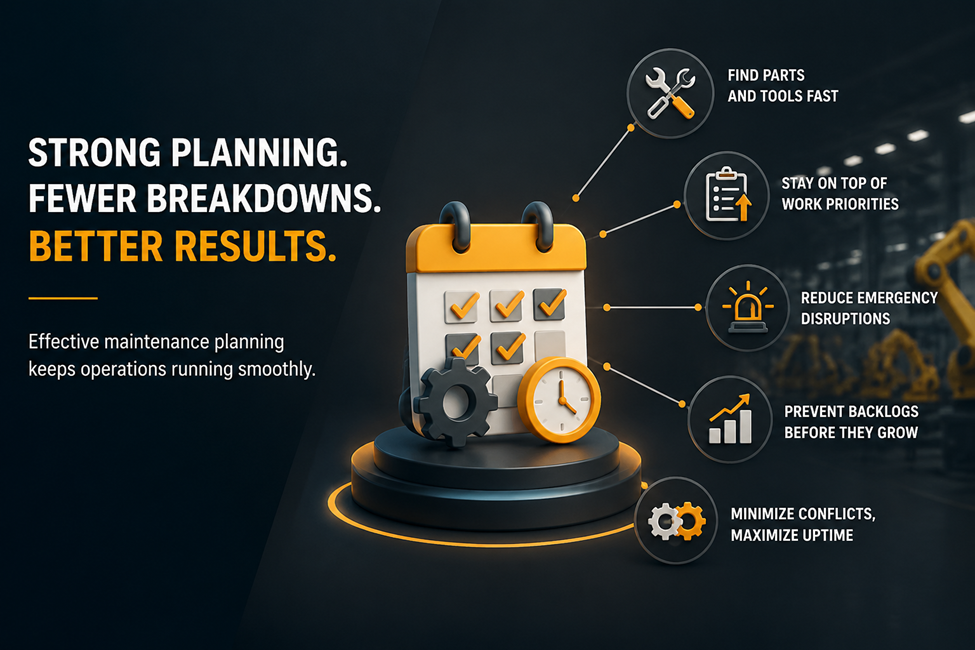
Maintenance planning and scheduling means preparing work before it is assigned, then committing it to a fixed weekly schedule. It is usually the highest-return maintenance and reliability practice available, because it converts lost technician hours into completed jobs.
Planning and scheduling are two different jobs. Planning answers what the job needs: parts, tools, procedures, permits and hours. Scheduling answers when it runs and who does it.
Without that discipline, technicians lose time locating parts, priorities shift daily, emergencies break the schedule and backlog grows unseen.
Disciplined manufacturers put a few things in place:
- A weekly scheduling routine with a schedule freeze
- Written job plans and planning standards
- A clear work prioritization system
- Backlog measured in crew-weeks
- Parts kitted and staged before the job starts
Use Predictive Maintenance to Catch Failures Earlier
Predictive maintenance in manufacturing uses asset condition data to find developing failures before they stop production. Instead of relying only on fixed intervals, it acts on evidence from the equipment itself.
Each technique detects different failure modes:
- Vibration analysis. Bearing wear, imbalance and misalignment.
- Thermography. Loose electrical connections and overheating.
- Oil analysis. Wear particles, contamination and lubricant degradation.
- Ultrasound monitoring. Air and steam leaks, plus very early bearing faults.
- Motor current analysis. Rotor bar and winding problems.
Adoption is accelerating. The global predictive maintenance market was estimated at USD 14.29 billion in 2025 and is projected to reach USD 98.16 billion by 2033, with manufacturing the largest end-use segment.
The programs that work integrate condition data into the planning process. Treating predictive maintenance as a standalone technology project is the most common way to waste the investment.
Implement AI for Predictive Maintenance in Manufacturing
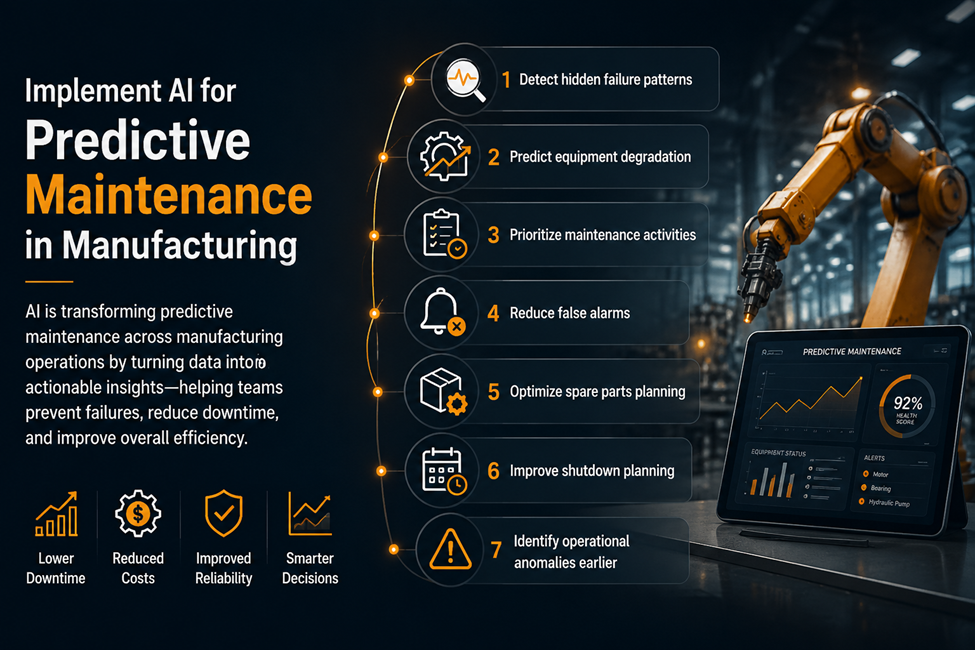
AI adds pattern recognition across large asset bases that manual monitoring cannot match. It can detect hidden failure patterns, predict degradation, prioritize work by risk and cut false alarms.
However, AI does not replace maintenance and reliability fundamentals. A 2026 review of AI and robotics in predictive maintenance found that model accuracies of 90% to 97% in laboratory conditions often fall to 65% to 75% in new operating conditions, with data quality and integration named as the main barriers to adoption.
That gap is closed by execution, not by a better algorithm. The strongest implementations pair AI insight with maintenance discipline, real-time visibility and standardized workflows.
The business case follows the same logic, which we cover in our analysis of AI predictive maintenance in manufacturing and its real ROI.
Focus Maintenance Resources on Critical Assets
Criticality analysis ranks equipment by business risk, so that maintenance and reliability effort follows consequence rather than habit.
Criticality is scored on two axes. Consequence covers safety, environment, production loss, quality impact and repair cost. Likelihood covers failure history and current condition. The output is a ranked asset register, not an opinion.
That register drives preventive task frequency, spare parts stocking, where condition monitoring goes first, and reliability engineering priorities. Reliability Centered Maintenance and Failure Modes and Effects Analysis pay back fastest on the assets at the top of it.
Standardize Root Cause Problem Solving
Repairing failures without eliminating their causes creates recurring instability. A structured Root Cause Analysis process ensures lessons become permanent corrective actions rather than repeated repairs.
Effective programs define three things up front:
- The trigger. A repeat failure within 90 days, an event above a cost threshold, or any safety incident.
- The owner. Someone accountable for closing the corrective action, not just filing the report.
- The input data. Failure codes captured at work order close, plus a monthly review of the worst assets.
The discipline of finishing the corrective action matters more than the method used to find the cause. 5 Whys, fishbone and fault tree analysis all work when the team has real failure data to examine. Most programs stall after the investigation rather than during it, when the corrective action is written down but never scheduled, funded or verified. Closing that loop is what turns a repaired failure into an eliminated one.
Manage Spare Parts and MRO Inventory
A planned job without staged parts is not actually planned. Strong manufacturing maintenance programs link stocking policy to criticality:
- Critical spares held for high-consequence assets, even at low usage
- Min and max levels reviewed against real consumption
- Obsolete and duplicate stock removed from the storeroom
- Clean materials data, so parts can actually be found
This is a quiet source of downtime, because the delay shows up as a maintenance problem rather than an inventory problem.
Improve Data Quality and Asset Visibility
Poor asset data undermines maintenance and reliability reporting, along with failure analysis, planning and inventory control. When equipment is named inconsistently and work orders close without a failure code, the plant loses the record it needs to see what is breaking, how often, and what it is costing.
Strong digital foundations include a standardized asset hierarchy, consistent failure codes, work order data standards, dashboards built on trusted numbers, and a CMMS that reflects how work actually happens.
Data quality is also a people problem. Experienced technicians hold knowledge that never reaches the system, and it leaves when they do. We explore that risk in knowledge loss as one of mining’s biggest AI opportunities.
How Do You Measure Maintenance and Reliability Performance?
You measure maintenance and reliability performance with a small set of KPIs a leadership team can act on weekly. Tracking forty metrics and improving none is a common failure pattern.
A practical core set:
- Planned maintenance percentage. Planned hours divided by total maintenance hours.
- PM compliance. Preventive tasks completed inside the compliance window.
- Schedule compliance. Jobs completed as scheduled for the week.
- MTBF. Reliability trend for critical assets.
- MTTR. Speed and quality of response.
- OEE. Availability multiplied by performance and quality.
- Wrench time. Share of a technician’s shift spent on the tools.
- Backlog in crew-weeks. Whether the workload is under control.
Each metric needs an owner and a review point. A KPI with no escalation path is a report, not a control. Decide in advance which number triggers a conversation and who is expected to act on it.
Create Shared Ownership Between Operations and Maintenance
Reliability cannot sit entirely inside the maintenance department. Shared accountability means operator care routines, basic inspections during the shift, cleaning standards, early defect reporting and cross-functional reviews. Operators become active participants in asset health rather than people who report failures after the fact. That shortens the time between a defect appearing and someone acting on it.
Develop a Reliability-Focused Culture
Technology and processes alone do not sustain maintenance and reliability improvement. Reliable plants reinforce precision maintenance, accountability and standardized execution. In practice that means training, planner and scheduler capability building, and supervisor standard work.
Practitioner guidance on creating a reliable manufacturing culture makes the same point. Behaviour on the floor, not the toolset, decides whether gains hold.
Use a Management Operating System to Sustain Results
Many initiatives fail because improvements are never embedded into daily management. A Management Operating System (MOS) is the routine that keeps maintenance and reliability performance visible and owned. It is a tiered structure:
- Shift level. Short handovers covering safety, output and equipment issues.
- Daily plant level. Yesterday’s losses, today’s schedule, open escalations.
- Weekly cross-functional level. Backlog, schedule compliance, repeat failures, resourcing.
Each tier has a fixed agenda, a defined KPI set and a clear escalation trigger. A vibration alarm nobody reviews is not a predictive maintenance program.
This is where reliability stops being a project and becomes how the business runs. We describe the wider operating model in beyond asset performance excellence.
Why Maintenance and Reliability Programs Fail
Most programs fail on execution, not on technical grounds. The engineering is rarely the hard part, and the same handful of patterns turns up across plants of very different size and sector:
- Technology is bought before work management is fixed
- No asset criticality, so effort is spread evenly and thinly
- Planners are pulled into reactive work and stop planning
- Failure codes are not captured, so root cause analysis has no data
- Leadership attention ends at go-live
- Operators are never brought into the program
Each of these is preventable, and none of them is solved by buying more software. They are decisions about sequencing, ownership and attention, which puts them with plant leadership rather than with a vendor.
How to Start
There is no single correct starting point, but the order below works for most plants. It front-loads the cheap changes and holds back the expensive ones until the basics can support them:
- Baseline planned maintenance percentage and the top sources of downtime.
- Rank assets by criticality.
- Fix planning and scheduling before investing in technology.
- Deploy condition monitoring on critical assets first.
- Install the daily management cadence.
- Build internal planner, scheduler and reliability capability.
The most common ordering mistake is running step 4 before step 3. Condition monitoring installed on top of a broken planning process produces alerts nobody has the capacity to act on, and the technology then takes the blame for a work management problem.
Why Maintenance and Reliability Best Practices Matter

Reliability affects nearly every measure of manufacturing performance: stable operations, higher asset utilization, better schedule adherence, lower operating costs and improved customer delivery.
The financial case reaches beyond the maintenance budget. Uptime is increasingly discussed as a working capital lever rather than a maintenance cost line, because unplanned failure ties up inventory, labour and cash.
The highest-performing manufacturers understand that reliability is not only a maintenance objective. It is a business performance strategy.
Key Takeaways
- Reactive work still dominates most plants, and it costs more than it appears to.
- Planning and scheduling delivers the fastest return of any maintenance and reliability practice.
- Criticality analysis decides where effort and monitoring should go.
- Predictive maintenance works when it feeds the planning process, not a dashboard.
- A small KPI set with clear owners beats a large one with none.
- A management operating system is what makes improvement permanent.
Frequently Asked Questions
What is the difference between preventive and predictive maintenance?
Preventive maintenance runs on a fixed interval, such as every 90 days or every 500 operating hours. Predictive maintenance runs on evidence, using condition data such as vibration or oil analysis to act only when equipment shows a developing fault.
What percentage of maintenance should be planned?
Most industrial operations target 80% or more of maintenance hours as planned and scheduled work. Below 40% indicates a reactive plant. Aiming for 100% is unrealistic, since some emergencies are genuine.
How do we know we are moving from reactive to proactive maintenance?
Two signals move together. Planned work percentage rises and emergency work orders fall. If only the first moves, the categories in the CMMS are probably being relabelled rather than the work changing.
What are the most important maintenance and reliability KPIs?
Planned maintenance percentage, PM compliance, schedule compliance, MTBF, MTTR, OEE, wrench time and backlog in crew-weeks. Each needs a named owner and a weekly review point.
How do you decide which assets are critical?
Score each asset on the consequence of failure, then weigh that against failure likelihood. The result is a ranked register that drives maintenance strategy and spares.
What role does AI play in predictive maintenance?
AI detects failure patterns, prioritizes work and reduces false alarms across large asset bases. The strongest results come when its output is wired into planning, scheduling and escalation routines rather than left in a dashboard.
Do you need a CMMS to improve reliability?
No. A CMMS makes good work management scalable, but it does not create it. Plants that install a system without fixing planning, failure coding and accountability end up with faster access to unreliable data.
What is a management operating system in manufacturing?
It is the fixed routine of tiered meetings, KPI reviews, escalation rules and leadership standard work that keeps daily performance visible and owned. It prevents improvement from decaying after a project ends.
How long does it take to move from reactive to proactive maintenance?
Most plants see measurable change in planned work percentage within two to three months of fixing planning and scheduling. Cultural gains take twelve to eighteen months, and depend on leadership consistency more than on tooling.