
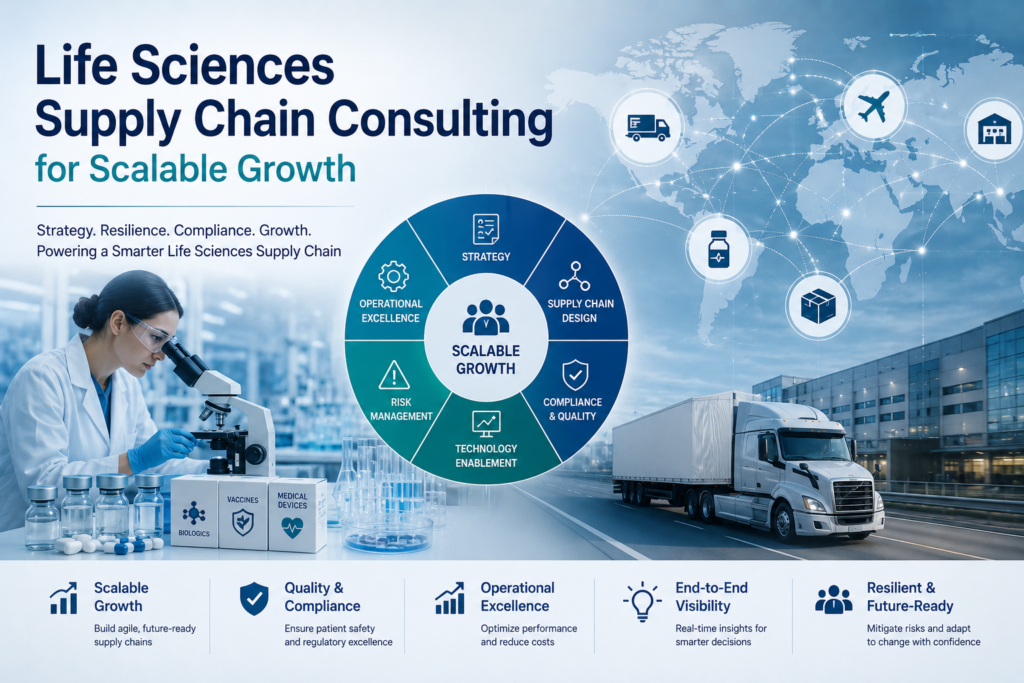
Why Operational Excellence Matters More Than Ever
Supply chain consulting has become essential as life sciences manufacturers face unique supply chain challenges. Product complexity, strict regulatory requirements, fluctuating demand, and increasing customer expectations all place enormous pressure on planning and execution. Whether operating in the pharma supply chain or adjacent sectors, organizations are expected to reduce costs, improve service levels, accelerate product launches, and support business growth.
Many companies have invested in ERP systems planning software and digital tools. Yet they continue to struggle with inaccurate forecasts manual planning processes inventory imbalances and disconnected decision-making.
Technology alone is not enough. Building a scalable supply chain requires the right operating processes, data governance, and execution. Effective life science supply chain consulting helps align these elements without over-relying on tools.
Why Life Sciences Supply Chains Struggle to Scale
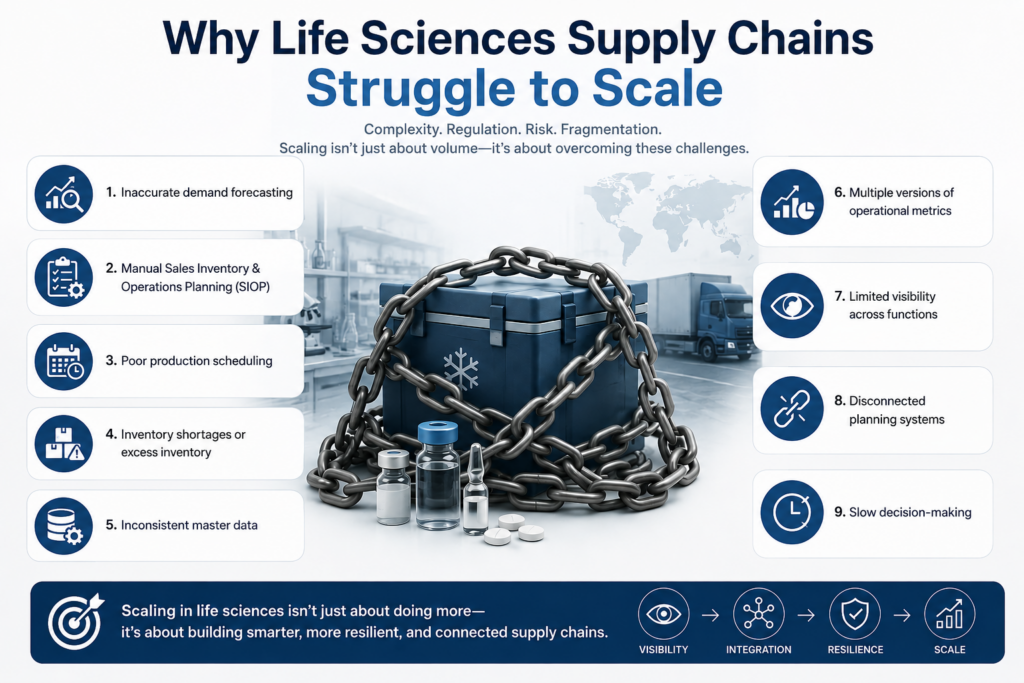
As organizations grow, supply chain complexity grows with them, including those operating within the Life Sciences Supply Chain and the pharma supply chain.
Common challenges include:
- Inaccurate demand forecasting
- Manual Sales Inventory & Operations Planning (SIOP)
- Poor production scheduling
- Inventory shortages or excess inventory
- Inconsistent master data
- Multiple versions of operational metrics
- Limited visibility across functions
- Disconnected planning systems
- Slow decision-making
These issues often become more visible during periods of rapid growth new product introductions acquisitions or network expansion. Without a structured operating model supply chains become increasingly reactive.
What Life Science Supply Chain Consulting Should Deliver
The goal of supply chain consulting should not simply be process documentation or software implementation. It should create a supply chain capable of supporting long-term growth while improving operational performance.The goal of supply chain consulting should not simply be process documentation or software implementation. It should create a supply chain capable of supporting long-term growth while improving operational performance.
Leading organizations focus on several critical areas.
Sales Inventory & Operations Planning (SIOP)
An effective SIOP process creates alignment between commercial forecasts production capacity inventory strategy procurement and financial objectives. Rather than functioning as a monthly reporting exercise SIOP should become the organization’s primary decision-making process for balancing demand and supply.
Planning and Scheduling
Production schedules should be stable enough to support efficient manufacturing while remaining flexible enough to respond to changing customer demand. Improving planning discipline reduces schedule changes improves asset utilization and increases on-time delivery.
Forecast Accuracy
Reliable forecasting depends on more than statistical models. Organizations need standardized forecasting processes consistent assumptions cross-functional collaboration and clearly defined performance metrics. Improving forecast accuracy helps reduce inventory while improving customer service.
Master Data
Master data is one of the most overlooked drivers of supply chain performance. Strengthening supply chain master data ensures consistent decision-making and reliable planning. Inaccurate item masters inconsistent bills of material duplicate records and conflicting planning parameters create planning instability throughout the organization. Without trusted master data even advanced planning systems struggle to deliver reliable results.
Operational Metrics
Many organizations measure supply chain performance using inconsistent definitions. Metrics such as On-Time In-Full (OTIF) schedule adherence inventory turns forecast accuracy and customer service should be standardized across the organization. A single version of operational truth enables faster better decision-making.
Technology Supports the Process — It Doesn’t Replace It
ERP platforms planning software analytics tools and AI applications can significantly improve supply chain performance. However technology cannot compensate for inconsistent processes or poor data quality. Organizations often discover that before AI can optimize planning or scheduling they must first improve data integrity standardize business processes and establish effective governance.
The strongest digital transformations begin with operational discipline and supply chain optimization consulting that aligns people, processes, and technology.
A Practical Example
Implementation Engineers recently partnered with a life sciences manufacturer preparing for significant business growth. The organization had implemented modern business systems but continued to face operational challenges. Planning processes remained highly manual forecasting required significant translation effort operational metrics lacked consistent definitions and supply chain processes needed to scale to support ambitious growth objectives.
The engagement focused on strengthening SIOP planning and scheduling operations digital transformation and master data to build a supply chain capable of supporting future expansion. Rather than beginning with technology the project focused on establishing the operational foundation required for sustainable improvement.
This approach recognized that sustainable supply chain performance depends on people processes data and technology working together. Similar patterns and outcomes are common in medical device consulting engagements as well.
The Role of AI in Life Sciences Supply Chains

Artificial intelligence is creating new opportunities across the Life Sciences Supply Chain. Organizations are beginning to apply AI to demand forecasting, inventory optimization, production scheduling, procurement analytics, supplier risk management, customer service, and supply chain scenario modeling.Artificial intelligence is creating new opportunities across life sciences supply chains. Organizations are beginning to apply AI to demand forecasting inventory optimization production scheduling procurement analytics supplier risk management customer service and supply chain scenario modeling.
However AI delivers the greatest value when implemented on top of mature operational processes. Without reliable data and standardized planning AI simply automates existing problems.
Choosing the Right Life Science Supply Chain Consulting Partner
When evaluating life science supply chain consulting firms, manufacturers should look beyond software expertise or strategic recommendations.
An effective partner should be able to:
- Improve operational planning processes
- Strengthen SIOP
- Optimize production scheduling
- Improve master data quality
- Standardize operational metrics
- Align technology with business objectives
- Drive organizational adoption
- Implement sustainable operating routines
Experienced supply chain consultants help organizations move beyond strategy and successfully execute long-term operational improvements.
The objective is not simply to improve planning. It is to build a supply chain capable of supporting long-term business growth.
Final Thoughts
Life sciences supply chains are under increasing pressure to deliver greater agility reliability and efficiency while supporting innovation and regulatory compliance. Building a scalable supply chain requires more than new technology. It requires operational discipline standardized processes trusted data and effective execution.
Organizations that strengthen these operational foundations through pharma supply chain consulting and experienced supply chain consultants are better positioned to improve customer service, reduce costs, support future growth, and realize greater value from digital technologies and AI through targeted life science supply chain consulting.
Q&A
Why isn’t technology alone solving life sciences supply chain challenges?
Tools improve visibility and speed, but they can’t fix inconsistent processes or poor data. Many organizations have modern ERPs and planning software yet still struggle with inaccurate forecasts, manual planning, inventory imbalances, and siloed decisions. Scalable performance requires operational discipline—standardized processes, trusted master data, clear governance, and execution routines—so technology can support, not replace, the operating model.
What are the most common signs a life sciences supply chain is struggling to scale?
Typical symptoms include inaccurate demand forecasts, manual SIOP, poor production scheduling, inventory shortages or excess, inconsistent master data, multiple versions of metrics, limited cross-functional visibility, disconnected planning systems, and slow decision-making. These issues often surface during rapid growth, new product introductions, acquisitions, or network expansion, pushing organizations into reactive modes without a structured operating model.
What should an effective SIOP and planning/scheduling process deliver?
A mature SIOP process aligns commercial forecasts, capacity, inventory strategy, procurement, and financial objectives, serving as the primary decision-making forum to balance demand and supply—not just a monthly reporting exercise. Planning and scheduling should produce stable yet flexible production plans that reduce schedule changes, improve asset utilization, and increase on-time delivery, creating predictable execution while responding to changing customer needs.
Why are master data and standardized operational metrics foundational?
Master data quality directly drives planning stability. Inaccurate item masters, inconsistent BOMs, duplicate records, and conflicting planning parameters undermine even advanced systems. Likewise, standardized definitions for OTIF, schedule adherence, inventory turns, forecast accuracy, and customer service create a single version of operational truth, enabling faster, better decisions across functions.
How should organizations approach AI, and what should they expect from the right consulting partner?
AI creates value in demand forecasting, inventory optimization, scheduling, procurement analytics, supplier risk, customer service, and scenario modeling—but only when built on reliable data and standardized processes. Otherwise, it automates existing problems. The right consulting partner focuses on building this foundation by strengthening SIOP, improving planning and scheduling discipline, elevating master data quality, standardizing operational metrics, aligning technology with business objectives, driving organizational adoption, and implementing sustainable governance and routines. A practical path starts with operational discipline, then layers digital and AI capabilities for scalable, long-term growth.